
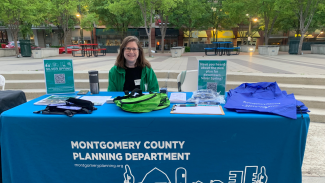
The architect who combines public engagement with urban design
Licensure gave Atara Margolies, AIA, the freedom to ask, “What else do I want to do in the built environment?” See why in this Q&A.
In 2023, AIA supported the retiring of the “rolling clock” requirement in the architectural licensure process. Data showed that this policy was a potential barrier to licensure, with disproportionate impacts on women and individuals from racially and ethnically diverse backgrounds.
Two years later, we’re highlighting licensed architects whose paths to licensure were shaped by the former five-year requirement.
Everyone’s path to licensure looks different, and every licensure success is worth celebrating.
Atara Margolies, AIA, LEED AP, is a planner III with Montgomery Planning, which is part of the Maryland–National Capital Park and Planning Commission, an agency that serves Montgomery and Prince George’s Counties in suburban Maryland. Her job involves a mix of urban planning and public engagement. She graduated from the University of Pennsylvania’s architecture school in 2004.
Read on to learn more about Margolies’ career, why she chose urban design, and how she balanced starting a family with pursuing licensure.
What drew you toward working in architecture?
I was an artistic kid, but I was also a very pragmatic kid. Somewhere around 10th grade, I decided that architecture was a synthesis of math and art, two things that I really enjoyed, and this was something I wanted to study.
What drew you toward working as a planner specifically?
[In graduate school], I signed up for an urban design theory class with Jonathan Barnett, who is one of the great urban designers in the United States. This was my first exposure to urban design, and the big-picture thinking really intrigued me. I decided to then get not just a master’s in architecture but also a certificate in urban design, which allowed me to take some additional urban design classes. I learned very quickly that I wanted to be an architect and an urban designer.
I got very lucky during graduate school and landed an internship with the Lower Manhattan Development Corporation, which was the entity set up after 9/11 to plan the reconstruction of Lower Manhattan and the World Trade Center site. In the internship, I learned how important public planning can be in setting up the stage for great architecture. And so I left that internship with an entirely new view on where my career might take me.
Can you share more about your career path before and after licensure?
After school, I went to a firm in New York called Cooper Robertson and Partners. There was a group doing urban design there, and I really loved it. I stayed in that group for seven years.
Around 2008, I began to realize that if I want to be a licensed architect, I needed a wider range of experience [instead of just urban planning]. Then, I had my first kid in 2011, and I leveraged the maternity leave break to say, “I’m going to come back to work, but you’re going to put me in a different group, and I’m going to work on buildings now.” That’s when I started focusing on the path to licensure.
This was seven years after I graduated. By 2012, I finally felt prepared to start taking exams. Our family moved to DC in 2014, and I took a job at Quinn Evans, a firm that did not have a planning or urban design studio. I felt I needed to go somewhere where I could just work on buildings to focus on licensure. [At Quinn Evans, two projects she worked on were Dorothy Hamm Middle School and an addition to the Hylton Performing Arts Center.]
My last exam was in 2018. Over the course of that time, I had two children, and I was pregnant with my third child when I passed the last exam.
How did getting licensed change your career opportunities?
Having a license in hand gave me the freedom to say, “What else do I want to do in the built environment?” Now that I'm a licensed architect, I can maintain that forever. I don’t need to work in an architecture firm anymore to hold on to that title.
An opportunity came up at Montgomery Planning to join as the project manager for a new master plan for downtown Silver Spring, Md. Earlier in my career, I was on private sector teams hired by municipalities to do their master planning, and this was an opportunity for me to see that from the municipal side.
I've been in that job since 2019. It has also afforded me an opportunity to make a lifestyle change. Public sector planning work moves at a slower and more organic pace than private sector architecture. If we think a project needs more time for engagement, we can make that happen.
-
 Montgomery PlanningMargolies works with a discussion group at a community meeting.
 -
 Montgomery PlanningMargolies presents at a community meeting.


Do you have any favorite buildings or projects that you look back on?
The Silver Spring project was my first opportunity to see a master plan from start to finish, including everything from the very first pre-engagement meetings all the way through the approval and adoption of the master plan. The whole thing took place during COVID, which was a very challenging environment in which to ask people to focus on the future. And I learned a lot about public engagement from that process that has informed everything I’ve done since.
In master planning, public engagement is probably 50% of the job. A lot of times, we are coming into communities, and people are stressed and frustrated. But we come in at the start to listen and understand what’s going on in the community. How can we help this community grow, thrive, and even transform itself into a place that works for everyone?
As someone who had children during the licensure process, do you have any advice for people balancing families and careers in architecture?
You need some good support, and it can be done, especially now without the pressure of that first exam expiring at a certain time. I was lucky in that every time you had a kid, you used to get an extension on the rolling clock. I got two of those during my time, which allowed me to buy an extra year. Without that, it would have been hard.
And my husband took on many solo Sunday mornings or afternoons with our small children to allow me to study in peace. I could not have done it without him.
Really, it’s about finding your village. It’s important to have a support system to help you balance your career in most professions and particularly in architecture.
Any other advice you’d like to share?
When you’re early in your career, make sure you are going to a firm that supports the juniors in the firm pursuing licensure. Some firms are super supportive and will help get you those hours that you need, or give you a range of experiences, or set you up with a mentor. And for some firms, it’s not a priority.
If you’re interviewing, do not be afraid to ask how a firm supports junior staff on the path to licensure. A supportive environment can make a big difference.
Danielle Steger is AIA’s senior manager, editorial & publications.