
Back to the table
Jeff Seabold, FAIA, on the value of architects who get involved in civic leadership roles.
This is the third installment of The Other Drawing Set, a five-part series on self-advocacy and leadership in the architecture profession. See the sidebar for previous entries.
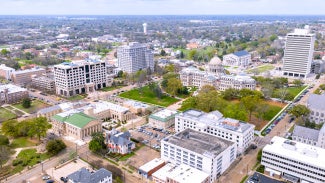
I have been called a disgrace in public for a volunteer job that pays nothing. The job is a seat on Jackson, Mississippi’s Historic Preservation Commission, where I have served for over a decade. The owner who called me that had decided to start tearing down their historic building on a Saturday morning and got caught, yet apparently, I was the disgrace.
Most of the commission’s work is quiet. Most homeowners who come before us are doing the right thing and trying to make their places better, and we try hard to help every applicant get to the best version of their project. The trouble usually comes from people who know better: The developers and contractors who thought they could get away with something.
That is when the room changes. Neighbors show up in droves. Tones are elevated with every comment. Then comes the groveling: “Just let me do this, this one time.” More than once I have left that room wondering whether standing up in it was going to get me sued.
I understand why the neighbors come. Property values are part of it, but it runs deeper than that. These neighborhoods carry an identity that matters to a lot of people, and when they start changing, people get curious and concerned about what is happening to their home. Over the years, I have watched projects approved that should not have been, and projects denied that deserved better. I have also watched what happens to a neighborhood when the people making decisions about its built environment are not the people who understand how built environments shape the people who live in them.
Most of the time, architects are not in that room. We are in the office finishing construction documents while the developer, the attorney, and the city planner decide what a neighborhood will look like for the next 50 years. The work gets done. The room moves on. And nobody in that room had the training to ask the question that matters most: How does this building shape the people around it, not just the people inside it?
Where the third places went
In 2023, the U.S. surgeon general declared loneliness a public health epidemic. The numbers behind that declaration are not abstract:
- Social isolation increases the risk of premature death by 29%, a risk comparable to smoking up to 15 cigarettes a day.
- Half of American adults report measurable levels of loneliness.
- Between 2003 and 2020, the time Americans spent with friends fell from roughly an hour a day to 20 minutes.
- Social media moved into that vacuum, and heavy users are about twice as likely to report feeling isolated as light users.
These are not just public health numbers. They are planning numbers.
Sociologist Ray Oldenburg spent his career documenting what he called third places, the informal gathering spaces between home and work where community actually forms. They include the barbershop, the diner, the front porch, and the park bench, all places where you run into a neighbor you did not plan to see. Oldenburg argued that suburban planning helped destroy those spaces, replacing walkable, mixed-use neighborhoods with car-dependent corridors where the only places to be are the places you drive to on purpose. Loneliness is one of the long-term outcomes of that planning philosophy.
People with access to third places report stronger trust and connection to their communities. But the people without them are not writing letters to planning commissions asking for them. Architects know how to design those spaces, but cities rarely build third places themselves. They write the zoning that decides whether anyone else is allowed to. The question is whether we are in the room when those rules get written.
The impact of an architect
I am one architect on one commission in one city. My presence there has mattered in specific ways. We rewrote the city’s historic preservation ordinance, and we keep revising it. We have helped add neighborhoods like Midtown to the National Register of Historic Places, which opens the door to state and federal historic tax credits for the people who own and invest there. In the city’s local historic districts, owners who do the work the right way can also qualify for property tax exemptions. And in the Farish Street Historic District, a neighborhood that had gone decades without the right kind of investment, Gulf Coast Housing Partnership is restoring and rebuilding 67 homes.
Some wins start with simply knowing what you are looking at. The building at 111 North State Street, in the Spengler’s Corner Historic District, sat abandoned after the bank foreclosed on it. To most people, it was a foreclosure. It took an architect to notice “Mockbee” carved into a brick at the top of the stairs, know it meant architect Samuel Mockbee, and recognize what the building was and what it could be. We designed its rehabilitation for the developer who brought it back, and it became my office for many years.
None of that happened because I had the best design ideas. On Farish Street, my part was working with Belinda Stewart, FAIA, and her team to help make the presentation drawings easier for the commission to digest, so we could approve the whole package quickly. That is not design work. It is knowing what questions to ask and when to step out of your lane for the cause of better. The planning commission meeting where the future of a neighborhood gets decided is not a technical meeting. It is a leadership meeting, and the profession keeps sidelining its best technical minds.
The evidence for why architects should seek civic leadership roles is now in the surgeon general’s advisory. The built environment is a public health issue, and architects are among the few licensed professionals in the room trained to think about how space affects the people who inhabit it. In a statement for this article, AIA Chief Advocacy Officer Alexander Cochran, Esq., put it this way: “The professional education and training that architects obtain provides them with unique skills that naturally align with roles and responsibilities of serving on local government boards and commissions.”
But when architects are absent from planning tables, zoning boards, city councils, and historic commissions, that expertise does not get replaced. It gets skipped.
Finding your way to the table
Finding the table closest to you is not as hard as it sounds. Most cities have some version of a planning commission, a historic preservation board, an architectural review committee, or a housing authority. Many of them are desperate for people who understand buildings and care about what happens on the street. Getting a seat usually takes a letter, a resume, and the willingness to show up.
We, architects, talk a lot about wanting to raise our value in society. Well, my friends and colleagues, this is where that starts. There is no magic pill or spell to cast. It takes two things: the decision that this particular conversation is worth having, and your butt in the chair.
That is the decision this article series is asking the profession to make. It starts at the local level. The pay is nothing. The cost of not being there is everything.
The remaining articles in this series will cover how to have tough conversations about regenerative design and how to reclaim our own authority in the rooms where the decisions get made.
Jeff Seabold, FAIA, NCARB, LEED AP, is the founder of Seabold Architectural Studio in Jackson and serves as an AIA at-large director for 2026–2028.
The views expressed here are the author’s own and do not represent the position of AIA or the AIA Board of Directors.