
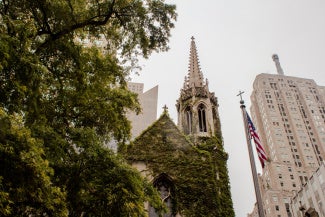
Designing for faith and reflection
How today’s designers of faith-based buildings and spaces approach their craft.
Because so many spaces for worship are stunning, they are often what sparks a person’s love for architecture, regardless of their religious faith or lack thereof. For many, this passion begins in youth, perhaps when we first enter the nave of a neo-Gothic cathedral or a Renaissance-era Roman basilica, or when we gaze upon some other awe-inspiring temple, synagogue, or grand edifice devoted to deities of old. These places move something in us because they feel ineffably sacred.
For architect Todd Kraft, a principal with HGA, the gateway project was St. Leo Catholic Church in Pipestone, Minn., designed by renowned architect Edward Sövik in the late 1960s. “That was the first building I encountered where I understood that architecture was something special,” Kraft says. Like many midcentury modernist churches, St. Leo’s outward appearance is more like a public school than a house of worship.
Sövik’s oeuvre, which includes notable projects like Northfield Methodist Church, built in 1964, and Christiansen Hall of Music’s Urness Recital Hall at St. Olaf College, built a decade later, represent prototypes for what Kraft calls “seeker-friendly” design, meaning that it is welcoming “for people who are looking for meaning, looking for God in their lives.” He continues: “We want the building to feel approachable and not turn people away because they aren't from a particular faith or background.”
The evolving role that faith-based spaces, religious institutions, and houses of worship play in contemporary societies has greatly transformed how the design community (and the congregations themselves) approach such buildings. Given how varied modes of worship have become, any attempt to identify what best practices look like today versus a few decades or centuries ago is a futile exercise. But there are some bedrock principles worth heeding for any design professional looking to enter the field.
Balancing contemporary and traditional
Sövik designed “single-space” churches, which reflected his belief that people were the most important element in his designs and should therefore be physically united. That core principle has not been abandoned by contemporary designers, but many of today’s churches, synagogues, and the like are much more intentional in their versatility.
“There is a lot of complexity in working on places of worship,” says Jacquelyn Block, AIA, principal and director of institutional practice at GFF Design, based in Dallas, and a member of AIA’s Interfaith Design Knowledge Community (IDKC). “There are some similarities to schools. You have large assembly spaces, outdoor spaces, and places for gathering. Designing faith-based projects is about community building, and I think that sometimes gets lost in architecture in general.” One case study Block cites is a new Lutheran chapel on the campus of Concordia University, a project that deftly blends elements of education and cultural design while adopting a sustainability-minded approach to material reuse and preserving the local watershed.
To commune implies a social structure that is indivisible, but communities and congregations are rarely monolithic. Even people of similar faiths have varied preferences for how to worship, and the religious architecture community has taken note. Kraft cites examples of larger churches that “now offer traditional and contemporary forms of worship,” where congregants can opt to gather in a more intimate space or an auditorium that can fit a few thousand. The type of space and mode of worship will also greatly inform acoustical design, with smaller spaces needing to be more reverberant than their mega-church counterparts.
Increasingly, some suburban churches have taken advantage of what Block calls “underutilized space” by converting them into things like coffee bars, playgrounds, and coworking spaces that are open to the public. While owned by the churches, these spaces also operate as forms of passive community outreach.
Faith forms the architecture
“If you’re a fan of architecture, then inevitably you’re going to encounter religious buildings,” says Michael Goldblum, AIA, principal with Building Studio Architects and another leading member of the IDKC. When it comes to designing them, he says, “I look at it through two lenses. One is the historical aesthetic lens, and the other is a more practical examination of how faith forms the architecture.” To illustrate this distinct marriage of form and function, Goldblum recollects when he learned the chapel in Le Corbusier’s Couvent Sainte-Marie-de-la-Tourette was sized to fit two rows of monks “lying on their bellies in the center of the room. … That’s the nexus between practice and form!”
Goldblum’s own projects may not take such esoteric considerations into account, but he’s a stickler for details. “Even when we're doing basic layouts, we’re thinking: How is this going to feel?” (He’s referring to the physical and emotional comfort of congregants.) “Does the placement of the structural grid affect the experience of the space? How is the egress going to affect the width of the seats? How is the AC going to affect the section of this room?”
Currently, Building Studio is completing work on New Square Synagogue in Spring Valley, New York, set to become the fourth-largest synagogue in the world. While things like window placement, right-sizing rooms, and air flow are critical for such a massive building, Goldblum says the client remarked that his firm’s initial design scheme was “too professional” and looked “too architectural,” akin to a modern Reformist temple. Further revisions leaned more into a neo-Classical form, heeding the Hasidic community’s wish for something more traditional.
For Hiroshi Nakamura of NAP Architectural Office in Tokyo, the spirit of the site itself informs schematic design. “When I design a chapel or a church, I don’t begin by asking what form should be placed on the site. Instead, I first consider what kinds of presence and relationships already exist there,” he says. Nakamura cites factors like topography, wind, light, vegetation, water, and soil conditions as tangible reference points, as well as the common memories and religious history that define the site.
One such project, Sayama Forest Chapel, completed in 2014, bears a light footprint in deference to the elemental forces that sustain the chapel’s building site and its forest surroundings, which “can carry a form of sacredness that is open to all,” Nakamura says. To avoid touching the branches, the chapel’s upper edges converge as they incline upward, where the aluminum-paneled rooflines resemble hands clasped in prayer.
Spaces for interfaith practice
Another notable balancing act is how to design for interfaith communities, where rituals and beliefs vary but the need for communion is constant. According to Joan Soranno, FAIA, a design principal with HGA, “Interfaith use means wide variation in how people come together—formality versus informality, collective versus individual expression, spoken versus silent ritual. … One of the biggest challenges is resisting the instinct to make a space feel neutral, which can often read as placeless. Interfaith spaces need to be open but still meaningful.”
This outlook comes through in projects like Lakewood Cemetery’s Garden Mausoleum, an expansive and starkly beautiful building. The design goal “was to create a shared emotional ground where different beliefs can project their own meaning,” Soranno says. Spaces for people seeking “a sense of something larger than themselves” is a bedrock of all architectural practice. It’s a calling to design around the rituals of the human experience.
However cryptic that may seem, Soranno offers these sage words: “Organized religion is changing … but the desire for meaningful, transcendent environments hasn’t gone away—it has simply shifted.”
Justin R. Wolf is a freelance writer covering architecture and design. He lives in Maine.