
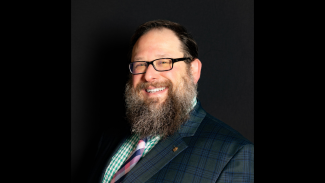
How one architect weaves identity, practice, and LGBTQIA+ advocacy
Spencer Lepler, AIA, reflects on the personal experiences that shaped his path to leadership.
During the last decade, LGBTQIA+ architects and allies have made their voices heard across the industry. By establishing local and national member groups, leading educational and social programming, and advancing formal equity commitments within firms and across AIA, they have helped move the profession toward greater inclusion and belonging. These efforts, rooted in visibility, data, and community, continue to shape how architects enter, experience, and lead in the field.
In celebration of Pride Month, we spoke with Spencer Lepler, AIA. He is the vice president of architectural and engineering services at Adaptive Property Solutions as well as the founder and chair of AIA Northern Virginia’s LGBTQIA+ Alliance. Here, he reflects on how his identity informs his approach to work, leadership, and advocacy, and shares practical steps he believes can strengthen support for LGBTQIA+ practitioners.
Answers have been edited for concision and clarity.
Tell us about your professional path and career so far.
I tend to explain things using fiber arts language because that’s a big part of my life. My husband and I have a side business called The Fiberists where we dye yarn and process fiber, and I knit, crochet, and weave. So, when I talk about my identity or my career, I think of them as threads that get woven together. I’ve always sought to find the right mix of technical work, personal flexibility, and leadership and community engagement threads as I’ve built my career.
I completed my studies at Tulane University in 2005 with bachelor’s and master’s degrees in architecture as well as a certificate in preservation studies, and then I worked in firms for a few years. Next, I took a nontraditional role at the National Council of Architectural Registration Boards supporting ARE testing efforts, which opened my eyes to other paths within the profession.
I worked at a few other firms in the Northern Virginia and Washington, D.C., region before joining Adaptive Property Solutions, where I’ve built and grown our architectural and engineering services division. I lead a department that provides as-built and asset documentation for architects, engineers, and large clients. The department also supports cross-functional technology and workflow development.
You’ve said bringing your full self into architecture matters. When did that become important to you?
I came out when I was at Tulane and stepped into student leadership to help revive a campus LGBTQIA+ group called MOSAIC. That experience taught me how important visibility and community are. When I entered practice, I found that openness largely disappeared. My colleagues rarely talked about their family lives, and policies, benefits, and support related to LGBTQIA+ individuals didn’t seem visible in the workplace.
Going from seeing what visibility could look like and then not seeing it at work motivated me. I began to engage more with AIA to advocate for data, programs, and spaces that acknowledge and support LGBTQIA+ members, including with efforts like the early Equity in Architecture surveys, which led to a much more robust support network across the organization.
How do you describe your identity, and how does it influence your work?
I identify as homoromantic gray asexual. That means my romantic partnerships are with men, but sexual attraction is rare for me. Understanding that about myself has been clarifying personally and professionally. It taught me that people’s inner lives are varied and that identity isn’t a static, singular thing.
Professionally, it sharpened my ability to listen and to see perspectives that aren’t the default. That outsider vantage point helps me build networks of people, connect threads across different stakeholders’ needs, and really think about the people who use spaces I contribute to building.
-
 Cabay PhotographyLepler (left) appears on a panel at the 2025 AIA Virginia Architecture Exchange.
 -
 Spencer LeplerLepler (farthest right) and other members of the AIA Northern Virginia LGBTQIA+ Alliance at a committee social event.


How does your perspective shape your leadership and advocacy with AIA?
Being outside the majority makes you practice empathy deliberately. I try to put myself in other people’s shoes, even when I don’t share their views. That skill is essential for building committees, programs, and events that connect us as practitioners and as LGBTQIA+ individuals. It also means recognizing when people can’t be visible for personal safety or career reasons and making sure the organization still signals that they belong.
Tell us about starting the AIA Northern Virginia LGBTQIA+ Alliance and what you’ve learned about sustaining it.
The alliance grew out of the big energy and strong LGBTQIA+ programming at AIA 2024 in Washington, D.C., and conversations I had with peers who wanted a formal, well-resourced committee locally—not just a social group. We intentionally sought board support and budget parity. As the only LGBTQIA+ alliance in our area, we have established it as a multi-chapter, multi-state initiative, inviting people from AIA|DC, AIA Potomac Valley, AIA Virginia, and AIA Maryland to engage with us.
We host quarterly in-person dinners, monthly planning meetings on Zoom, and occasional larger programs like educational sessions intended to raise key issues for firms about benefits, HR policies, and building inclusive workplace culture. Two years in, I think my big lessons are that it’s important to tie into existing resources, set realistic programming expectations, and partner with other committees so the alliance’s priorities are heard across the chapter.
You contributed to the book Out In Architecture, volume 2, which was just released this month. What does your essay include?
My essay traces the arc from my college organizing with MOSAIC to founding the AIA Northern Virginia LGBTQIA+ Alliance. It also looks at my setbacks and personal growth along the way. I wanted to show that queer presence in architecture is both personal and structural. Our stories matter, and so do the policies and awareness that make our participation in the profession possible. Being a part of the publication is really meaningful, and I’m proud to be part of it.
Looking ahead, what do you hope to see for LGBTQIA+ architects and the profession?
First, it’s crucial that we work together to protect the gains we’ve made. Our visibility and programs where we openly participate matter because they tell young architects they belong.
Second, I hope for deeper structural change. We need to continue to champion getting better demographic data to understand our professional community’s breadth, advocate for all firms to have equitable HR benefits, and build partnerships across AIA chapters.
Third, I want to ensure we keep our mentoring efforts and coalitions alive. Those of us who can be visible should keep showing up so others know the support is there.
Kathleen M. O’Donnell is a freelance writer, editor, and communications strategist based in Washington, D.C. She is committed to telling stories that provide useful insights to architects and designers and highlight the impact of their work.