
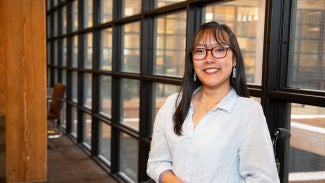
Making accessibility “more than a checkbox”
Rachel Wiesbrock, Assoc. AIA, explains why advocating and designing for people with disabilities and diverse lived experiences is essential for a better built environment.
Each July, Disability Pride Month marks the anniversary of the Americans with Disabilities Act (ADA), which passed on July 26, 1990. For architects and designers, this month is a reminder that accessibility for people with disabilities and mobility challenges leads to better, more inclusive places for everyone.
To honor Disability Pride Month, we spoke with Rachel Wiesbrock, Assoc. AIA, an accessibility specialist at Chicago-based LCM Architects and an at large director on the AIA National Associates Committee. Her work blends technical knowledge, lived experience, and community advocacy.
Answers have been edited for concision and clarity.
How did your identity and early life lead you to focus on accessibility in architecture?
Rachel: I was born in South Korea with a congenital muscle weakness called arthrogryposis and was adopted to a small town in northern Illinois when I was 11 months old. I didn’t really notice barriers growing up until I went to a summer camp run by the Great Lakes Adaptive Sports Association (GLASA) for children with disabilities, where I would watch other kids play freely and then be stopped by a curb or a rough threshold. Their wheelchairs or mobility devices would get stuck, and their whole mood would change. That contrast and hardship stuck with me, especially when I began to use a wheelchair more frequently years later.
In third grade, I told my opa (grandfather) that I loved art and math, so he encouraged me to study architecture. I didn’t quite know what that was at eight years old, but as I got older, it felt like a natural fit, and I always had this sense that having a disability would help me make places more accessible.
I went on to study architecture at the Illinois Institute of Technology. My college experience was very rewarding, but it also exposed me to spaces that weren’t as welcoming to people with disabilities as they could and should be. My education and experiences navigating Chicago pushed me even more toward pursuing accessible design and disability awareness as my career.
What do you do as an accessibility specialist at LCM?
Rachel: I mainly conduct plan reviews, site surveys, and accessibility consulting for commercial and hospitality projects, including cruise ships. The cruise work is interesting because it forces me to think differently about things like how maritime law and the ADA don’t always line up, and ship layouts create unique constraints. I love partnering with designers who intentionally blend form with function. My role is to help translate lived experience and code into usable, welcoming spaces.
What perspective and leadership approach do you bring to your role on the AIA National Associates Committee (NAC)?
Rachel: The NAC represents the Institute’s entire Associate membership, which includes perhaps the broadest spectrum of AIA members, including those who pursue licensure and those who choose alternative career paths. Personally, I’d like to be licensed someday, but right now my specialization in accessibility feels more central to what I contribute, and that helps me advocate for the membership needs of people with non-traditional paths.
NAC reinforces that there are many different, meaningful ways to be a part of this profession. I want the entire industry to value diverse expertise so people can build meaningful careers without feeling diminished for not following a traditional path in practice.
-
 Mo ZainaRachel (farthest right) with the 2026 National Associates Committee Advisory Committee.
 -
 AIA IllinoisRachel with AIA Illinois delegates at the 2025 AIA Leadership Summit.
 -
 AIAAttendees of the 2026 AIA National Associates Committee Annual Meeting at the AIA Global Campus for Architecture & Design®.
 -
 GLASAThe GLASA Young Professionals Board at the 2026 Annual GLASA Gala.
 -
 Chicago MOPDAt the 2025 Chicago Disability Pride Parade with Rachel Arfa, the commissioner of the City of Chicago Mayor's Office for People with Disabilities.
 -
 Courtesy of Rachel WiesbrockHolding the ISA symbol on a cruise survey in Glacier Bay, Alaska.


Tell us about your other advocacy and community engagement efforts, both within architecture and outside of it.
Rachel: Community and advocacy are essential for me. I am an extrovert, so I really enjoy reaching out across the profession to raise awareness and invite others to share their experiences. I am always honored to be invited to participate in panels and speaking engagements, and I am trying to be visible so other people with disabilities can see themselves reflected in our profession.
I recently attended an event hosted by Access Living of Metro Chicago where I engaged with the broader local community of people working in disability services. I also serve as the president of the GLASA Young Professionals Board, which is a full-circle experience. It’s truly a wonderfully fulfilling experience to serve the organization where I had that initial spark to enhance accessibility, all while collaborating with people from different professions to support GLASA’s mission to provide adaptive sports programs for people of all ages and different ability levels.
Who in the accessibility field do you admire, and what do you draw from their work?
Rachel: First, I was inspired early on by Jack Catlin, FAIA, a founding partner of LCM whose legacy is a touchstone for accessibility specialists. I’ve also been following and admiring the leadership and advocacy work of Karen Braitmayer, FAIA, and Olivia Mae M. Asuncion, AIA, for years. I got a chance to spend time with both at the AIA Conference on Architecture & Design® in San Diego this year.
In addition to speaking on numerous panels and sessions, they rallied together to help fix my wheelchair when my front wheel jammed. They demonstrated what it means to show up for others in our community, and it was incredibly moving. Those human moments always remind me how I think about design: It must be rooted in care.
What are the biggest obstacles to better accessibility in architecture, and where are the clearest opportunities?
Rachel: Standards, codes, and policies vary greatly across jurisdictions and building types, so fragmentation is a big obstacle. Another persistent problem has to do with the perception that accessibility is a burden in design. I have started to ask people, “Are you designing for the law or for the people?” From day one, I have always said that accessibility and inclusion is way more than just a checkbox during the design process.
We have a massive opportunity to reframe accessibility as a design advantage, and that is what I try to champion. Others have said it before, but culturally, we need to change the language and treat accessibility as a baseline, not an afterthought. When we design for everyone from the start, spaces are better for all users.
I would love to see the profession fund accessibility specialists and embed them in project teams as valued partners the way sustainability consultants often are. If we teach accessibility as integral to design beyond the simple mandate to comply with code, we will be able to move the built environment forward. The more we intentionally include people with disabilities throughout the design process, the more naturally we will realize that accessible design is good design.
Kathleen M. O’Donnell is a freelance writer, editor, and communications strategist based in Washington, D.C. She is committed to telling stories that provide useful insights to architects and designers and highlight the impact of their work.