
Meeting in the middle to reimagine bridges
A new wave of bridge projects finds architects and engineers in unique collaborations.
The Rock Island Bridge in Kansas City, Mo., became a new kind of civic infrastructure due in part to a funny observation.
After seeing the skeletal span during a boating trip, former PBS executive Mike Zeller remarked that someone should build a restaurant on it called “Chicken on a Bridge.” But he didn’t stop at a joke; instead, he started efforts to transform the crossing, which spans 702 feet over the Kansas River.
Next came years of work and advocacy powered by a belief that the abandoned structure could find new purpose. As a result, the former cattle bridge has turned into a public gathering space, complete with an event venue, room for restaurants, and a trail that will connect it with the adjacent West Bottoms neighborhood. It had a soft opening in November 2025.
Forming a team early
The Rock Island Bridge project was the apex of years of collaborations and discussions on how to overcome challenges, including dealing with municipal boundaries, building across a floodway, and retrofitting an old steel railroad bridge to hold hundreds of people and public trails. It’s part of a new approach to retrofitting public infrastructure that Dennis Strait, AIA, believes will become more common. Strait is a principal at Multistudio, the architecture firm behind the Rock Island Bridge project.
“There was a lot of interesting collaboration that had to happen before architecture became a discussion,” said Strait. “Before, an architect might originally have gone through and created a conceptual design and then brought on the engineering and the consulting team to figure out how to execute it. We learned you’d be much better served getting consultants in early to figure out as much about the problem to be solved before putting a solution on the table.”
Matt Farber, a structural engineer with the engineering firm Thornton Tomasetti, has worked on the project for five years. Farber became involved as part of a unique collaboration between his firm, another engineering firm called TranSystems, and Multistudio. “There was a lot of work to prove out the concept,” said Farber.
The project required teamwork to make the former rail bridge function and add space for people, bikes, trails, and entertainment, all in a setup that balanced on existing supports and structures. To abide by local building codes, the bridge had to become a public way to allow for enough exits from the event space. Eventually, engineers found ways to expand the 14-foot-wide crossing to 40 feet.
“TranSystems was very familiar with other bridge fixes,” per Farber. “There can be corrosion, other aspects that aren’t maintained. So it’s important to work with someone familiar with these structures.”
Seeking new challenges
A number of new bridge projects have linked architects and engineers in unique collaborations, seeking to work close together on designs that bring new visions to these spans while overcoming unique constraints absent from traditional architectural efforts. In addition to the Rock Island Bridge, the 11th Street Bridge in Washington, D.C.’s Anacostia neighborhood is in the process of becoming an elevated park. Its designers, OMA and OLIN, plan to transform an abandoned highway into a new civic connector. The project’s team intends to break ground next year.
These projects take advantage of a new appreciation and desire for unique public spaces in urban areas, inspired by infrastructure projects like the High Line and capped highway parks that meld engineering and public park access. It helps that advancing design software has unlocked possibilities for more complex engineering.
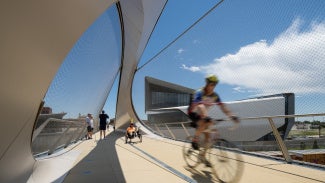
Other recent bridge projects involved engineering not just a solution but a new way to assemble a project. In 2020, Diller Scofidio + Renfro (DS+R) oversaw the installation of the Park Union Bridge in Colorado Springs, Colo., a sinewy steel curve above an active railyard. The span united the firm’s U.S. Olympic & Paralympic Museum complex with a nearby park. It also stretched the firm’s structural engineering skills. In collaboration with the consultancy Arup, the DS+R team figured out which of three different versions would be the most structurally sound, considering variables such as wind resistance, how to deal with retaining water, and the most ideal way to include space for cyclists and wheelchair users.
The end result was a stretched, tied arch with steel skin that went across the rail line and curved left to right, allowing it to be shorter and structurally viable. Collaborating in software tools like Rhino, Grasshopper, and proprietary programs used by Arup, the teams figured out the final form. They had it shipped in pieces to the site and welded together in chunks to shorten the delay of the active rail lines below.
“We architects studied structural engineering, of course, but we’re not regularly designing 250-foot spans,” said Holly Deichmann, AIA, an associate principal at DS+R. For Deichmann, these projects can’t work unless both parties can make concessions, collaborate, and refuse to be entrenched.
At one point, the preliminary shape of the bridge was looking good, but the curved span didn’t quite make the connection to the bridgehead, sitting just a foot off. Instead of refusing to problem solve, the engineers took that small gap as a challenge. They redoubled their efforts and figured out how to tweak the shape.
Selling a vision
In Portland, Ore., the car-free Tillikum Crossing is a cable-stayed bridge across the Willamette River that opened in 2015. It features dedicated space for pedestrians, bikes, and rail transit. Architect Donald MacDonald, FAIA, who once designed toll booths for the Golden Gate Bridge and worked on the Tillikum Bridge project, said he utilized many hand-drawn plans as he interacted with engineers and sought buy-in from the public. Showing physical sketches made the project proposals feel more considered and helped him explain the ways he was literally and figuratively drawing from the landscape. (The Tillikum project utilized the profile of nearby Mount Hood.)
Bridges differ from buildings in their impact on the landscape, said MacDonald. Because they’re often expensive, stand out amid the urban landscape, and take years to build, they are very symbolic developments that attract lots of feedback. MacDonald believes that makes it all the more important for architects to work closely with engineers to sell their vision, backed up with extensive research and study.
Collaborations between architects, engineers, and contractors continue throughout the design and build process. Farber said the intricacies of the Rock Island project didn’t stop when they figured out the structural challenges of supporting public space and new amenities. They decided to galvanize the steel to protect the overall structure and give it a longer lifespan.
The contractors who worked on the project had experience with bridges, making it easier to figure out how to approach and sequence construction above the river. “Dealing with a very old bridge that was being loaded very differently than what the original intent was meant they had to scrutinize it and make sure it was right,” said Farber.
With so many of these projects finished or under construction, architects have examples to draw from for future civic infrastructure projects. Beyond the symbolism of bridges as connectors, there are also extensive opportunities to turn abandoned structures or overlooked crossings into something new.
“There are hundreds if not thousands of bridges that are abandoned and have significant capacity to do something like Rock Island,” said Farber. “I definitely think it’s possible when this opens, that it gets a lot of national attention and starts to encourage others to try something similar.”
Patrick Sisson is a freelance writer covering architecture and design. He lives in Los Angeles.