

Rethinking the ROI of existing buildings
Retrofits are playing an increasingly important role in decarbonizing the built environment.
The cumulative weight of all manufactured things now exceeds the weight of the living world (plants, animals, and so on). Most of that manufactured tonnage is attributable to our built environment. And there is still much to build, particularly in the Global South, to house a global population that’s inching ever closer to 10 billion.
Given that reality, it is imperative that we not only design new buildings that are attuned to a warming planet but become better stewards of the buildings we already have. There’s red in the ledger, so to speak: Buildings continue to emit more carbon than they sequester.
One tool for addressing this challenge is adaptive reuse and retrofits of existing building stock. As Kathleen M. O’Donnell recently noted, “Underscoring a broader recognition that climate stewardship begins with what already exists, mission-driven organizations are demonstrating how reinvesting in existing buildings can advance carbon-reduction goals and preserve heritage.”
The practice of adapting, renovating, decarbonizing, and future-proofing existing buildings represents a growing percentage of design firms’ portfolios. The result is a built environment that’s increasingly aligned with the health and wellness needs of humanity and the planet.
The embodied values of building reuse
Lori Ferriss, AIA, is a name worth knowing in the building reuse arena. Three years ago, she co-developed and launched Architecture 2030’s CARE (Carbon Avoided Retrofit Estimator) Tool, which calculates the environmental benefits of building reuse and retrofits. More recently, Ferriss and Billie Faircloth, FAIA, co-founded Built Buildings Lab, a nonprofit devoted to educating the public about the economics and what Ferriss calls the “embodied values” of building reuse.
“We’re seeing building owners want to make better use of what they already have,” she says. “Part of that comes down to economic efficiency and tapping into the value of what’s been built.”
That outlook represents the business case for reuse. Another incentive gaining traction in certain jurisdictions concerns policies like Los Angeles’ Adaptive Reuse Ordinance, which has helped facilitate the conversion of underutilized buildings into new housing. “Adaptive reuse is such an effective multi-problem solver,” Ferriss says, indicating it can tackle “decarbonization, economic resilience, community justice, and housing shortages.”
Economics and logistics
Policy-driven adaptation strategies cannot be separated from the straightforward economics and logistics of reuse versus building anew. Such matters were front of mind when the Stanley Center for Peace and Security was searching for a new headquarters in its homebase of Muscatine, Iowa.
Having operated out of leased office space in a downtown midrise for decades, the organization wanted a more visible presence as well as a home that embodied its values and mission of bringing people together to solve issues related to climate change, nuclear proliferation, and mass violence. Working with their design partner, Iowa-based Neumann Monson Architects, the Stanley Center weighed the quantifiable pros and cons of various sites, a list that included some vacant brownfields and a handful of old buildings.
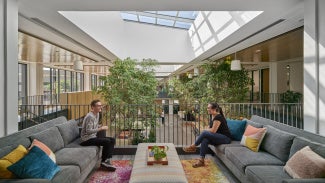
They eventually arrived at a 24,000-square-foot concrete block that once served as Muscatine’s public library but had sat vacant for years. The building was aging yet had a sturdy core and shell. Neumann Monson developed an iterative design plan that prioritized natural lighting, indoor air quality, renewable energy, water reclamation, and more, all focused on their client’s goal of achieving full Living Building Challenge (LBC) certification, which is pending. (The building was recognized as a 2025 AIA COTE® Top Ten winner.)
“You’re looking at what you have to work with and trying to keep as much [material] as possible or be smart with how you’re changing it,” says Lyndley Kent, AIA, a principal with Neumann Monson, regarding the firm’s methods. Kent’s fellow Neumann Monson principal, Khalid Khan, Assoc. AIA, calls this a “scalpel approach” to determining what materials and structural components are salvageable versus where the existing structure presents new opportunities to design from a “health and wellness perspective.”
To those ends, be it biophilic materials, a green roof, or enhanced air quality, wellness features are something clients “are generally on board with,” Kent says. A tougher sell can be retrofitting for optimal energy performance, because it raises pertinent questions related to costs for new equipment, operations, and maintenance.
Meeting the social imperative
Costs are an important factor, but there is another perspective to consider: that of clients who view decarbonization and energy-efficiency goals as social imperatives that are inextricably linked to their wellness goals. The Stanley Center falls into that camp. A growing number of higher education institutions do as well.
Boston-based architecture firm Goody Clancy has both an extensive portfolio of higher ed projects and a deep bench of sustainable design accolades. According to Elaine Hoffman, AIA, who is Goody Clancy’s director of sustainability, “Many higher ed institutions have made serious commitments to fully decarbonize their campuses. Many of these buildings are 20 to 100 years old or older and have been operating off steam or high-temperature hot water, and they need to [convert] to help campuses meet what are now institutional decarbonization targets.”
At Dartmouth College, in Hanover, New Hampshire, the firm took a dual approach when working on the school’s Arthur L. Irving Institute for Energy & Society (another 2025 AIA COTE honoree). The project involved making a high-performance addition to an aging 1970s-era building that includes an expansive new atrium and entryway that doubles as a natural ventilation feature.
The project’s conjoining of old and new resulted in “embodied carbon savings (through material reductions) and operational carbon savings (through passive strategies and system upgrades),” according to Goody Clancy’s award submission. Interestingly, new construction—which includes low-carbon concrete, low-impact insulation, and a super-efficient envelope—was leveraged to upgrade the building systems and enhance the energy performance of the existing structure. The building is now a teaching tool for how net zero built environments take shape.
Teaching clients to be better stewards
Not every client will come to the table with decarbonization, efficiency, and social wellness goals at the ready. Therefore, discovery of goals is often necessary. Myrrh Caplan, Skanska’s national senior vice president for sustainability, refers to identifying clients’ “pain points” early in the process of working with them.
“We’re going to look at building performance and all that, but first we’re going to listen,” she says. Individual pain points can include energy and other utility bills, occupant comfort, or maintenance issues. For Skanska, an international juggernaut in the construction and building performance space, advising clients on how to be better stewards of the built environment comes down to the clients’ dollars and cents.
“We’re going to look at the re-capitalization plan with the customer and talk about their long-term strategy,” Caplan says, explaining that Skanska uses tools such as gap analyses and energy metering. Performing such granular investigations tends to unearth a couple things: first, a client’s internal performance goals, based on their self-assigned pain points; and second, the types of compliance benchmarks they are legally obliged to meet, be it California’s Title 24, New York City’s Local Law 97, or some other energy code or emissions reduction target that directly informs any building owner’s cost model.
Seen through this lens, energy and financial goals become somewhat easier to align. Caplan stresses that this should be considered the first step, or an “initial evaluation” of where they want to end up. “No one does it all at once,” Caplan says.
But ideally, the process will lead clients toward buildings that are much better than the ones they started with. If that happens across enough projects, we’ll end up with a better built environment, too—a more broadly impactful form of ROI.
Justin R. Wolf is a freelance writer covering architecture and design. He lives in Maine.