
Why health care remains a strong market for architects
From outpatient clinics to hospital renovations, a steady pipeline of projects is keeping firms busy—even as economic uncertainty slows other sectors.
Amid the current economic stagnation that much of the design profession is facing, the health care market offers one beacon of light.
In July, the AIA Consensus Construction Forecast Panel predicted that spending on health care construction will increase by 4.4% next year, up from a 2.6% increase in 2026: “The aging U.S. population has lifted the demand for health care buildings, from hospitals to outpatient clinics and nursing homes.”
Health care makes up international firm HDR’s largest market sector for several reasons, according to the firm’s global health director, Jacqueline Foy, AIA, and its national health director,Sandy Tkacz, AIA. Demographic shifts are driving demand for medical facilities, Tkacz says; in Florida alone, more than 30 counties have experienced double-digit growth since 2020 from retirees and domestic and international migration.
Health care’s immunity to economic swings also derives from its universal need. “Preventative health care is a fundamental right that every person, every human being needs to have access to,” says Roderic Walton, FAIA, principal at Columbus, Ohio-based firm Moody Nolan and president-elect of the AIA Academy of Architecture for Health. “The need isn’t driven by market cycles.”
From conversations at industry events, Sizeler Thompson Brown Architects principal Steve Templat, AIA, affirms that “everybody thinks health care is still the best market right now, amongst these multi-market firms.” Health care projects typically make up 70 percent of his New Orleans firm’s billings, Templat says, but the figure is closer to 60 percent this year. “This was a reset year for us,” he says. “We came off a huge run of projects from 2020 to ’24,” and the firm predicted a short period in which clients would pause to revisit their capital needs. He anticipates a return to robust activity in 2027.
In the meantime, his 11-person firm remains busy with health care master planning, department planning, and approximately 15 enabling projects, prerequisite work for larger construction and renovation projects.
Changing care and practice models
Health systems are constantly seeking operational and financial efficiencies. “We have an aging population with chronic illness,” Foy says. To improve patient throughput, increase the number of beds for high-acuity care, and reduce patient recovery time at hospitals, health systems are adding off-campus facilities to provide low-acuity services. Laparoscopic and same-day surgeries are also relocating to outpatient clinics, Walton says. As health systems become more distributed, “buildings have to evolve to keep up.”
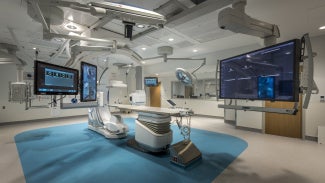
Though hospital shells may be expected to last 50 or 100 years, the technology and equipment inside have to be updated at regular cadences, Templat says. MRI, CT scan, and X-rays machines require replacement every decade or so, which often necessitates space planning or a room refresh. Though these projects could hardly be viewed as glamorous, Templat says, they contribute to the steady supply of health care work. “[These are] the day-to-day projects that we do a dozen [of] every year.”
Because much of the American health care system is private, health systems continue to compete for new territory, and their facilities must attract new patients. More recently, Templat has noticed that health care operators are “nibbling on not just the suburban edges, but the rural to suburban edges … for market capture.”
Paying due attention
Along with facilities that can flex for changing services and technology, Moody Nolan is seeing more clients focusing on “whole-person health,” Walton says, referring to how a patient feels psychologically and emotionally. Some providers are opening neighborhood care sites in shopping strip malls or community centers and adding daycares and fitness centers to support patients. “It’s a new model that’s exciting because it meets the patients where they are,” per Walton. “It’s a patient-centered model.”
Health systems are adding dedicated inpatient and outpatient facilities for mental and behavioral health services as well as renovating spaces to accommodate the different ways in which people process visual, auditory, and sensory information. “There’s a lot more emphasis on it because it is a major need everywhere,” Tkacz says.
Health systems are also prioritizing their medical professionals, who historically report high levels of burnout. They are hiring architects and design professionals to add breakrooms, wellness spaces, and fitness areas to help prevent physicians, nurses, and staff from suffering from fatigue, Walton says.
-
 Dan Schwalm/©2025 HDRDesigned by HDR, the Behavioral Health & Wellness Center at Children’s Nebraska features play as part of its care model.
-
 Dan Schwalm/©2025 HDRAnother HDR project is the Intermountain Primary Children’s Behavioral Health Center in Taylorsville, Utah. It emphasizes play areas and family spaces.


Embedding resilience
Seeing the increase in extreme weather events due to climate change, health systems are turning to architects for evaluating potential sites for new and replacement facilities. Rising sea levels are a frequent conversation topic for Foy and a client in Norfolk, Va. A location that looks great today may be partially submerged in a few decades. “If it’s not a good thing in 30 to 40, 50, 60 years, then are we making best use of those capital dollars?” she asks.
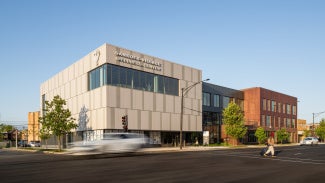
Resilience means something different for each client and project, Walton says. At Chicago’s Sankofa Village Wellness Center, resilience means the building, by architect-of-record Moody Nolan with associate architect Converge Architecture, can “withstand a trauma on its own,” he says. For example, if the area experiences an extended power outage during the summer, the building becomes a cooling center for residents. “How can the building adapt—not only to recover structurally from a natural disaster—but how can it serve the population?” Walton says. “We’re expanding the lens of what resilience means: to be people first.”
In Louisiana, resilient design was normalized in the aftermath of Hurricane Katrina in 2005, Templat says. Now his clients are implementing lessons from the COVID-19 pandemic and installing adaptable HVAC systems and building wings that can circulate 100 percent fresh air if someone simply pushes “a series of buttons—something that literally was impossible five, six years ago.”
Architects are also helping health care clients understand the impact of artificial intelligence to their space needs. Tablets and kiosks are reducing the need for large admissions areas, and robotics are increasingly participating in surgical procedures. Foy says HDR is helping health care operators understand “what are the elements that need to have a sense of permanence, and what are the elements that [we may not need] in 10 years?”
Entering the market
Health care design requires passion, rigor, and commitment. Having endured several recessions, Templat has seen “a few disasters happen [when firms start trying to get into health care] because they don’t have other work—not because they’re trained in it, they’re prepared to do it, or even understand what they agreed to.” After 36 years in the sector, Templat says he is still learning something new every day. “There is nothing like health care,” he says. “The complexity and the codes are just phenomenal.”
For firms and professionals wanting to enter the market, Templat recommends starting with outpatient clinics, business occupancy projects, and doctor or dentist offices. “They have their own complexity,” he warns, and “the [projects are] not sexy and not the big dollars. So, it’s not going to save anybody’s firm.” Firms can also try teaming up with other firms with established health care practices.
“It’s an amazing time to be a health care architect because we’re at this inflection point,” Walton says. “We’re talking about the influx of AI … and how it’s going to change project delivery. We’re talking about the digital divide [and what it means] for folks who are at the lower end of the social and economic scale. How do we safeguard health care so that it’s still accessible to everyone?”
Like health care providers who aim to deliver the best care to their patients, architects can make invaluable contributions to health care, Foy says. “It’s something that [brings us all] a great deal of personal and professional fulfillment.”
Wanda Lau is a freelance writer covering architecture and design and a former editor of ARCHITECT magazine. She lives outside Chicago.