

Ready for a career pivot? Start with what you know
Architects changing course don’t have to start over. Identifying transferable skills, finding mentors, and doing the research can make a new path more attainable.
Sustainability and urban planning seem to be top choices for graduating architecture students, but where an architect starts their career and where they end up over time has a lot to do with life itself, says Garfield Peart, FAIA, NOMA. Peart is co-chair of AIA’s Equity and the Future of Architecture Committee and one of the primary authorities on the 2025 AIA membership demographics report.
There are no statistics surrounding the number of architects who move from one practice area to another, but there are many reasons they pivot, Peart says. Typically, they do so “because they get married or relocate for family; for better opportunities within architecture or related professions; for economic reasons; or to follow a specific passion within the profession.”
But what does it take to leap from one discipline to another and find success? Here are three answers.
Conducting due diligence
First, there’s research. John W. Martin, AIA, LEED AP, had a nearly 30-year run in retail architecture for a firm in North Carolina, where he began as an intern and rose to director of design. He looked to pivot after the COVID pandemic, when retail developers were starting to reimagine the retail shopping model that, in his words, had “gone soft.” He encountered a crossroads that made him ask himself: “Do I stay with this firm or start looking for another opportunity where my 30 years of architectural background could transition into something else completely?”
Martin cast a wide net and landed on a job that specializes in justice architecture with CGL Companies, which provides holistic, proactive solutions that address issues affecting justice facilities and systems. Martin’s brother-in-law worked for the firm at the time, so Martin was able to ask a lot of questions.
When researching, he focused on what justice architecture encompassed and how he could use his knowledge in a new way. He found the change of focus interesting and felt his beliefs aligned with where justice architecture was headed. He also was interested in using his architectural talents “to help change the narrative from a past model of incarceration to one that now focuses on rehabilitation,” he says.
Martin discovered that some of the traits he “possessed as a retail architect transitioned nicely into justice architecture.” (He has outlined traits that help in justice architecture on his blog.) Even still, justice architecture is very different from retail because “it’s highly scrutinized,” requiring interactions with varying levels of government entities.
For Martin, who started on his new path in February 2025, there was a six-month learning curve just to come up to speed on what he needed to understand before he could integrate himself fully into justice projects. But he says he knew that “it would open my eyes and was going to challenge me for the next 10 years versus me staying in retail design–where I was comfortable and happy with my career.”
Erica Weeks, AIA, LEED Fellow, points to another type of research. In her roles as director of green building certification at Paladín and as a member of AIA’s Building Performance Knowledge Community, Weeks has contact with many students and job seekers. She suggests finding out if a potential new job requires a credential. “That gives you value when firms are comparing resumes. If you’ve already taken an exam or done the continuing education to support it, that’s a high-value mark,” she says.
Finding a mentor
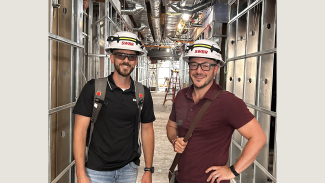
Jamie Bucci, AIA, LEED AP, a senior project architect at SWBR, bounced from education to industrial architecture and back again, only to land most recently on multifamily housing—all within the same firm. He has been with SWBR since graduating from Alfred State College in 2007 and beginning his career in SWBR’s education studio. There, he worked closely with the firm’s quality control manager who, he says, “mentored me through the technical aspects of the project we were working on.”
When the economy slumped in 2009, education work subsided, and SWBR had work for Bucci on an industrial project. He didn’t need any specific training to make the shift, but he began to learn about himself as an architect and the things he was more—or less—passionate about.
Pivoting requires a bit of introspection and knowledge about oneself. At some point, “people start to come to the realization of what they want to do versus what they’re good at versus what is valued within the organization. [These] may not be the same things,” says Bob Borson, FAIA, principal, senior project manager, and senior project designer at BOKA Powell. He discussed this topic on his “Life of an Architect” podcast.
“As long as you keep struggling with taking the time to evaluate your own skills and your own abilities, you’re going to be holding yourself back. If you keep fighting for this design position that you’ve always wanted, when you really should be a project manager, you’re just delaying your advancement and development of your career and your growth in your office,” according to Borson.
Bucci felt that industrial architecture, where he spent seven years, didn’t satisfy his passion for design. But he did like the project delivery method—working directly with contractors and having a seat at the table early on, which isn’t as common in education, he says. That project-delivery method is used more often in multifamily projects, “which is why I requested to make the switch.”
His in-house mentor stayed close to him over the years and thought this pivot would be good for Bucci. “Moving to multifamily was a big transition this late in my career,” Bucci says. “He advised me that while the logistics of the move at the firm would take some time, getting up to speed on how things worked would be manageable. And I’m grateful that I had the ability to do it here, all under one roof. I didn’t have to learn a whole new system from a different company.”
Starting with skills
Borson, too, changed paths. Earlier in his career, he moved from a small residential-focused practice to a larger commercial firm. He wanted to see what would happen if he was in “an environment that operated at a completely different scale,” he says.
The pace was a shock, and “adapting to that new rhythm meant rethinking how I approached design. The team dynamic was different, the process was different, and even the codes were different.” He also felt he had to earn credibility in a new environment where no one knew him.
Borson spent a lot of that adjustment period being reflective, he said. To find success, he leaned into roles that came naturally to him. “I became a communicator and a big-picture thinker, someone who could connect design intent to project delivery and help younger architects navigate the gaps between the two. … I’m more of a ‘why’ person than a ‘how’ person.”
Now, as a project manager, Borson doesn’t spend as much time on design as he used to. His desire to be useful, he says, puts him on tasks where he excels. “I don’t design less because I don’t want to [design]. I design less because I am needed more elsewhere.”
Weeks, too, focused on her skills before pivoting. Earlier in her career, while she was working on residential architecture in California, sustainable design was part of the ethos. She ended up moving to Nashville, Tenn., and worked for a firm that was branching out into sustainability consulting for architects, engineers, contractors, and others. “I became that go-to resource, which perpetuates project work and [also] perpetuates my fun excitement about continued learning.”
Changing career paths can produce a lot of anxiety, but it’s important to step back and look at the big picture. Says Borson on his podcast, “Many architects resist change because they believe that altering course means losing status or starting over, but that perspective misses the point. Growth rarely feels comfortable, and while fear of the unknown is valid, staying still isn’t always safer. The path you know may not be the one that leads you where you belong.”
Thinking of changing paths? Here are some resources:
AIA’s Knowledge Communities
Bob Borson’s “Life of an Architect” podcast episode, “Changing paths”
A relevant “Out of Architecture” blog post, “Beyond the traditional path: expanding career possibilities in architecture.”
Want to learn more about mentoring? Visit these pages.
Three programs for students are the AIA New York TORCH Mentorship Program, the ACE Mentor Program, and True North.
Mentoring Architectural Pathways is a leadership program from AIA Brooklyn.
AIA has resources on mid-career mentoring on its page dedicated to the topic.
Stacey Freed is a freelance writer focusing on architecture and design. She lives in Western New York.