
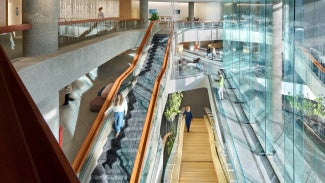
GCAD presents a model for performance excellence
Carbon neutrality and energy efficiency are paramount at the AIA Global Campus for Architecture & Design®.
Because AIA is behind the Framework for Design Excellence and the 2030 Commitment, it’s fitting that the organization owns one of the country’s first and largest net-zero commercial retrofit projects: the AIA Global Campus for Architecture & Design® (GCAD). Even with building experts on all sides of the project table, however, achieving GCAD’s performance goals took significant effort and creativity.
“This was, for [AIA], a real opportunity to think big and reflect on what we can accomplish as an industry and a profession,” says Julie Hiromoto, FAIA, a partner at HKS who served on the building committee for GCAD. The building committee was appointed by the AIA Board of Directors to streamline decision-making for the reimagining of the organization’s 180,000-square-foot headquarters, says project executive Stephen T. Ayers, FAIA. A basis of design report by Quinn Evans helped establish project goals, both for workplace design and energy.
A big mindset shift occurred, Ayers says, when San Francisco–based architecture firm EHDD and engineering consultant Point Energy Innovations (PEI) successfully interviewed for the project in 2020. (Rounding out the team: Hartman-Cox Architects and Hood Design Studio are the architect of record and landscape architect, respectively. The mechanical, electrical, and plumbing engineer of record is Affiliated Engineers.)
PEI managing principal Rami Moussa explains, “The metric that matters most around environmental impact and stewardship is carbon. At the end of the day, zero net energy is a proxy for reducing our carbon footprint.” Along with practical reductions in energy usage intensity (EUI), building electrification and carbon neutrality became GCAD objectives.
Optimizing operations
Eliminating fossil fuels at GCAD required the removal of decades-old, natural gas–powered equipment, including two boilers and a water heater. To both right-size and reduce the cost of a new rooftop heat pump, the team took a data-informed approach to identify practical reductions in GCAD’s electrical and heat load. These measures included installing a cool roof system with an R-40 rating, switching lighting systems to LEDs, and introducing demand-controlled ventilation throughout the building. The team also replaced the single-pane facade glazing with insulated low-emissivity glass.
The multistory exterior photovoltaic-integrated shading systems on GCAD’s south and west elevations may seem “above and beyond,” says EHDD partner and project sustainability director Brad Jacobson, FAIA, but they support occupants’ visual and thermal comfort and make electrification feasible. “If you have all that glass blasted with sun and heat, it’s hard to use heat pumps for cooling,” he says. “You will need more heat pumps, which are already space constrained.” Collectively, the upgrades to the building envelope and systems reduced the project’s initial EUI of upwards of 90 to the low 40s, Moussaf estimates.
As of today, the operational energy of GCAD’s AIA-occupied floors is carbon neutral. Between its rooftop and sunshades, the project has a nearly 80-kilowatt PV array, fulfilling about 10% of demand. The balance is procured via off-site renewable energy generation via DC Power Connect. “We helped AIA find a fully additional source,” Jacobson says.
-
 Interior space at GCAD with a biophilic wall.
 -
 GCAD's window coverings.
 -
 AIA 2026 President Illya Azaroff, FAIA, speaks at his inauguration at GCAD.


Neutralizing embodied carbon
By reusing its 1953 building designed by The Architects’ Collaborative instead of construction anew, AIA reduced the project’s embodied carbon by 76%, according to PEI. Though the Brutalist building’s concrete structure and envelope account for approximately half of its total embodied carbon—estimated at 3,057 tons of carbon dioxide equivalent by EHDD’s EPIC software—Jacobson says the interior architecture team optimized product selections to limit the addition of embodied carbon to half of that for a conventional fit-out. Low-carbon materials include mass timber for GCAD’s feature stair and low-carbon carpet tiles, ceiling finishes, and wallboard, says EHDD principal Rebecca Sharkey, AIA.
To offset GCAD’s embodied carbon and fulfill a project priority to benefit the local community, PEI worked with AIA to create a partnership with Habitat for Humanity Virginia and the nonprofit organization GiveSolar: AIA would donate $500,000 to install 5-kilowatt arrays on approximately 72 Habitat homes. Each homeowner would see about $925 in annual utility savings, and GCAD would achieve carbon neutrality in 15 years. The agreement between Habitat and GiveSolar with a corporate or business organization was the first of its kind, Moussa believes: “We hope to see [the model] proliferate.”
Building on success
GCAD serves as a model for the future of design, Ayers says: “If building owners are wondering whether it’s possible to [achieve] carbon neutrality through a building retrofit, we’ve carved out a way—and one that makes an investment in our local community.” Many owners can relate to pursuing “how far we can push energy efficiency within a reasonable cost,” Sharkey says. GCAD is pursuing LEED Platinum and WELL certification with workplace amenities that prioritize biophilia and occupant well-being, such as climbing plant walls and advanced air filtration.
Hiromoto advises teams with aspirational design goals to invite specialists early in their planning to ascertain the details and costs necessary to deliver concepts into reality. “You have to advocate for what you need as a professional to meet the job’s expectations,” she says. “Going through the trials and tribulations of innovation repeatedly teaches you that this is an expected part of the process.”
She reflects on the influence of the late Marsha Maytum, an early sustainability proponent who served on the AIA GCAD building committee and brought Hiromoto into the group. “She wanted someone to consistently advocate for the things that were important for this building and for the Institute,” Hiromoto says. “I know she would be proud of what we accomplished together.”
Wanda Lau is a freelance writer covering architecture and design and a former editor of ARCHITECT magazine. She lives outside Chicago.