
Inside AIA’s inclusive headquarters renewal
Learn about the welcoming design ethos behind AIA's redesigned headquarters in Washington, D.C.
For years, visitors arriving at AIA’s headquarters encountered an iron gate perched atop concrete stairs and flanked by brick walls. But today, the entrance is less of a challenge to visitors and more of an invitation.
The non-historic portions of the walls are now gone. A sloped wooden walkway traverses from the street to an activated courtyard, forming a link between the seven-story, 180,000-square-foot headquarters and the nearby historic Octagon building. According to EHDD principal Rebecca Sharkey, AIA, the new pathway is “universally accessible and much more welcoming.”
The humanized entrance is a fitting prelude to the newly renovated headquarters. The creation of the “once-in-a-generation project,” as described by former AIA executive vice president and CEO Robert Ivy, FAIA, involved reimagining the site’s Brutalism-inspired building, which was designed by The Architects’ Collaborative in 1973.
The five-year transformation exemplifies inclusive and equitable workplace design strategies (covered in this article) and environmental stewardship (to be covered in a future article). San Francisco–based firm EHDD led the project, collaborating with Hartman-Cox Architects, Hood Design Studio, Point Energy Innovations, and Turner Construction Company.
Walking the walk
The headquarters’ new name “reflects the openness that we wanted [the campus] to have,” says 2023 AIA President Emily Grandstaff-Rice, FAIA. “With over 200 chapters and 100,000-plus members,” adds 2024 AIA President Kimberly Dowdell, AIA, “we want to be inclusive. Even the name … signals this is not just about architecture.” For example, Dowdell continues, the multiyear project sparked the AIA HQ Renewal Internship, which brought architecture students from seven Historically Black Colleges and Universities (or HBCUs) to experience design and construction firsthand.
The AIA Building Committee envisioned a facility that would serve the public, its membership, and its staff, says committee chair and 2022 AIA President Dan Hart, FAIA. AIA staff had worked remotely since the pandemic, and a return to on-site work in the headquarters called for improving the space’s flexibility and comfort. Following a thorough user-engagement process, EHDD updated a basis of design developed by Quinn Evans with staff insights “about their experience working from home and what they wanted to bring to the new building,” Sharkey says.
One goal was to break down workspace hierarchies and increase connection across the five floors AIA occupies. While the ground-floor atrium and second floor had ample natural light and courtyard views through glazed curtain walls, the remaining floors were dark with low ceilings.
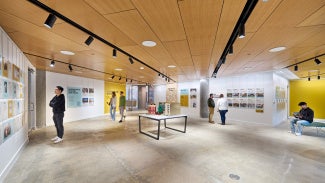
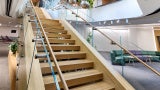
Now, Sharkey says, every floor provides a similar experience and design quality. One of the biggest changes is that EHDD carved a new floor opening with a connecting mass timber stair, located alongside the preexisting main stair between the ground and second floor. Placed along the south curtain wall, the floor opening delivers much-needed daylight and “activates the lower level,” Grandstaff-Rice says. West of the stair, a new ground-level event space creates much greater visibility and connection from the public courtyard space to AIA activities within, Sharkey says.
-
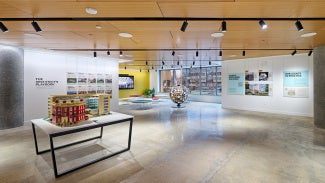 The bright lighting at AIA HQ in action.
 -
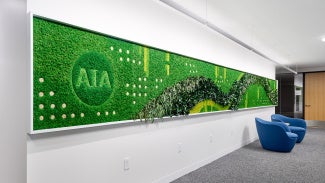 A nature-inspired surface at AIA HQ.
 -
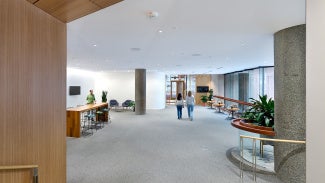 A walkway at AIA HQ.
 -
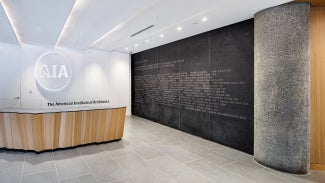 Wall at AIA HQ listing AIA's Gold Medal winners.
 -
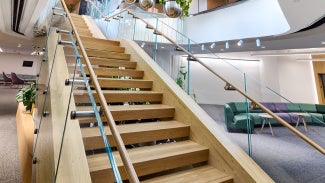 Stairway connecting AIA HQ's lower level with the first floor.


Welcomed upgrades
A multilevel climbing planter between the staircases is one of several biophilic design elements throughout the building. Its base forms a bench at the center of the lower-level social and amenities floor. Other floor amenities include a wellness studio, focus rooms, a library with access to AIA’s archives, a mother’s room, all-gender restrooms, changing facilities, and a virtual reality/media lounge.
On the second floor, there used to be an imposing tiered boardroom that could have passed for a Mad Men set. The renewal project renamed the area the Commons and flattened it to one level for greater accessibility and equity. Movable seating and tables and updated technology enable multiple setups for meetings and presentations.
At the west end of the second floor, coworking and meeting spaces address another past pain point of visiting AIA members: having “no place to take a phone call,” Sharkey says. Now members can keep up with their daily work while attending engagements at GCAD.
The fourth floor, whose primary users are AIA staff, shares the lower levels’ design language. A social gallery and coffee area are central among an array of diverse workspaces, including individual retreats for focused work and rooms for group breakouts. Private offices are now on the back wall, giving open team areas greater access to daylight and views. Incoming daylight is modulated by photovoltaic-covered sunshades with a diagrid-inspired frit pattern, creating a biophilic dappled light effect. The mix of informal and formal furniture and settings aims to improve department connectivity and support a hoteling desk policy.
To give relief and depth to these relatively short floors, EHDD opened select ceiling areas to expose the waffle slab structure. In the social gallery, textured felt baffles reinterpret the diagrid and support acoustical comfort.
Commercial real estate is in a time of reinvention, and the new AIA headquarters has made the “shift from a buttoned-up office building for a corporation to [a site that supports] a member-driven organization that has global ambitions,” Hart says. “This is a huge opportunity [to say] what’s important in architecture right now [is] being less insular and more outward-facing and present. This project hopefully embodies that mission in a physical way.”
Wanda Lau is a freelance writer covering architecture and design and a former editor of ARCHITECT magazine. She lives outside Chicago.