
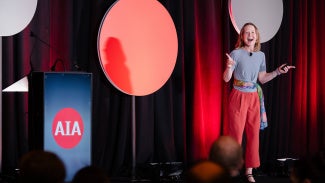
April Rinne teaches architects how to navigate change
At this year’s AIA Leadership Summit, writer and advisor April Rinne shared “superpowers” architects can use to move through uncertainty.
Last week, leaders from AIA chapters across the country came to Washington, D.C. for AIA’s 2026 Leadership Summit. On Friday morning, keynote speaker April Rinne gave a talk titled “Flux: The Mindset & Superpowers to Lead & Thrive in Constant Change.”
Rinne calls herself a “global citizen.” Her well-traveled background came in part from tragedy: The sudden death of her parents while she was in college spurred her to “see how the rest of the world lived, so I could figure out how to help, and hence what to do next,” per her bio. Along with traveling the globe, she has studied “law, finance, and development,” and she wrote the book “Flux,” on which her Friday talk was based.
During her talk, Rinne explained that when she talks about “flux,” she doesn’t mean a single new technology architects need to adopt or a one-off event firms must respond to. Instead, flux is about “constant, ongoing change and uncertainty.” Surviving and thriving in it requires a “flux mindset” or “fluxiness.”
To help AIA leaders develop their fluxiness, Rinne shared three of the eight “flux superpowers” her book discusses.
Superpower 1: Trust
Rinne called trust “the glue that holds teams and communities and cultures together.” She went on to say, “Trust is central and foundational, but also … emergent and evanescent. It can be hard to build and easy to lose.”
She thinks that as technology advances, trust will only become more important. Rinne acknowledged that it’s easy to watch the news and conclude that “the future is technology, AI, and chaos.” But, she continued, that deluge of technology will increase the value of human connection. “The more impersonal transactions we have, the more bots [we] interact with, the more personal connections matter.”
She distinguished between two types of trust that help build connections: cognitive and emotional trust. Cognitive trust means “trusting that people are reliable and dependable—that they will do what they say they will.” It comes from the head. Emotional trust, by contrast, comes from the heart and “means trusting that people care about and will look out for one another.”
Both types of trust are important. However, Rinne believes “most organizations over-index on cognitive trust,” yet “when big change and uncertainty hit, it is 95% emotional trust that carries the day.”
Rinne had good news for her audience: Because architects blend “physics and math” (which comes from the head) with “beauty and awe” (which comes from the heart), they are uniquely positioned to build both kinds of trust.
Start here: Rinne gave the audience a trust exercise to do in the moment—and you can do it by yourself or with your organization, too. It involves answering this question: Are you investing sufficiently in the different dimensions of trust that matter?
Superpower 2: Let go
Rinne’s next superpower was that of letting go. She explained that by letting go, “I do not mean giving up for failure. I do not mean letting go of your responsibilities or your budget. I’m talking about a different, deeper kind of letting go—a healthy questioning of your beliefs in order to get out of your own way.”
In Rinne’s view, sometimes “not changing actually creates greater risks” than keeping things the way they are. She encouraged the audience to think about letting go of:
- Past decisions
- Grudges or things you shouldn’t have said
- The belief that you’re supposed to have all the answers
As one example of why letting go is important, she pointed out that a leader who thinks they have all the answers may be prone to suppressing contributions from their colleagues.
Ready to let go? Rinne said you can start developing this power by asking yourself: What do you need to let go of to give AIA’s goals the best chance of success? (You can also modify the question to replace AIA’s goals with your firm’s goals—or even your personal goals.)
Superpower 3: See what’s invisible
Rinne’s final superpower was seeing what’s invisible. In her words, as you use this superpower, you will “start to see things that have been off your radar. You start to see things you’ve missed or just written off.” Rinne said it involves “questioning your beliefs and updating them as reality changes.”
The superpower counteracts two natural shortcomings of people. One is that people can’t foresee deep change. “In general, humans do not see things we’re not looking for, but also, we don’t see what we don’t expect or believe we should see.” Making matters more challenging, fear can “control us” and prevent us “from seeing new opportunities.”
The second shortcoming is that humans also have a hard time unseeing changes once they happen. Rinne gave the example of trying to imagine the world without smartphones or the internet—a challenging visualization for most.
Start seeing what’s invisible by answering:
- What do you struggle to unsee or unlearn? Is that getting in the way of how you lead people and harness opportunities?
- What do you see that you think is invisible to others? (Rinne suggested that whatever it is, you can benefit those around you by sharing it.)
In closing, Rinne said that while much of the world is uncontrollable, “You do have 100% control over whether and how you practice [your superpowers].”
Danielle Steger is AIA’s senior manager, editorial & publications.