
Fulfilling a dream through design
The team behind the National Juneteenth Museum plans to make it a cultural and economic center.
In 2014, Opal Lee of Fort Worth, Texas, began the tradition named Opal’s Walk for Freedom. Every year on June 19, Lee leads a 2.5-mile walk to commemorate the 2.5 years that passed between the Emancipation Proclamation, issued on January 1, 1863, and the legal decree that enforced emancipation in Texas, issued on June 19, 1865. Texas was the last state to free enslaved people.
The African American community has long celebrated Juneteenth, and Lee’s tireless advocacy led to the establishment of June 19 as a national holiday in 2021. (Fittingly, she is now known as the grandmother of Juneteenth.) Just one year after Juneteenth became a national holiday, the team creating the National Juneteenth Museum (NJM) unveiled plans for a facility in Fort Worth’s Historic Southside. Designed by Bjarke Ingels Group (BIG), the NJM is set to break ground later this year, with completion estimated for early 2028.
A confluence of visions
“This vision was cast in 2015, but originally it was a vision for a cultural center, and in particular a center where African American culture could thrive,” says Jarred Howard, NJM’s CEO. Related conversations continued with civic and business leaders in the ensuing years, and Howard assumed an executive post with Fort Worth’s Chamber of Commerce in 2018, but there was still little tangible movement towards realizing his vision.
And then, “Ms. Opal Lee came in one day,” he recalls. “She was looking for some support for her Juneteenth activities, and unfortunately, we weren’t able to help in the ways she might have wanted. But in the course of our conversation, I shared my vision, and she asked if I had a space.”
Howard responded, “not yet,” but that a location “in the general vicinity of Evans and Rosedale” was ideal. The Southside’s Evans and Rosedale corridor has long been the epicenter of Black culture in Fort Worth. Still, even though the area is just a few miles from the city’s central business district, economic investment in the neighborhood has lagged for decades, owing to the construction of I-35W in the 1960s. The interstate is a far-too-typical urban scar that bisected the Southside.
According to Howard, “[Lee’s] response was, ‘Well, I own property on the corner of Evans and Rosedale, and that property is yours.’” A confluence of visions occurred in this moment. Once completed, the NJM, of which Lee is a founding board member, will be “a catalyst of invitation,” Howard says, and a place that is part historical museum, part cultural center, and a living institution that brings together tourists, community members, and aspiring entrepreneurs. (The museum will be on the corner of East Rosedale St. and New York Ave., one block to the east.)
Reaching this combined vision took time, careful curation, and a boost from local benefactors. Earlier iterations of the museum’s design envisioned a relatively small building, approximately 5,000 to 7,000 square feet. But those early versions “simply did not reflect the grandeur that we envisioned,” Howard says. “The previous [versions] were the result of what we could afford, quite frankly.”
Amid these struggles, Howard was approached by Mark and Shannon Hart, whom he calls “good friends of the museum.” They shared Howard’s idea of realizing something “bigger and better.” The Harts facilitated an introduction with BIG and offered to underwrite a new design.
-
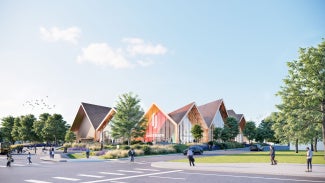 © BIG/Bjarke Ingels GroupExterior rendering of the NJM.
 -
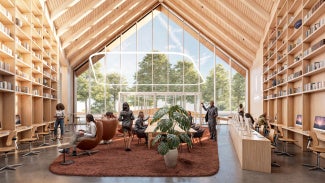 © BIG/Bjarke Ingels GroupRendering of a business incubator space at NJM.
 -
 © BIG/Bjarke Ingels GroupRendering of the NJM’s food hall.
 -
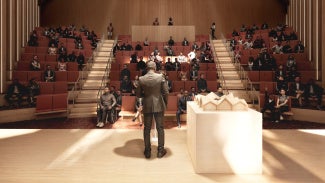 © BIG/Bjarke Ingels GroupRendering of the NJM’s auditorium.




BIG enters the picture
In late 2021, Howard first connected with BIG partner Douglass Alligood, FAIA, who has since left the firm to launch his own practice. In Alligood’s telling, “there was no design of a building yet. It was just possibilities. It was blocks of programs being shifted around to create different types of experiences, and those experiences were centered around community activation and integration.” Sans any conceptual designs, Howard presented to Alligood a “robust and ambitious” vision that included a food court, a business incubator, educational resources, an auditorium and performance spaces, museum galleries, and more.
As early design development commenced, Alligood describes a conceptual journey that started with interacting “program blocks” and evolved into “a campus kind of atmosphere” that transcended a typical museum. The conjoining of program spaces is integral to BIG’s design, and it allows the 68,000-square-foot building to literally radiate with purpose.
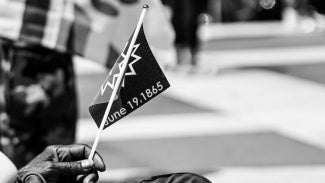
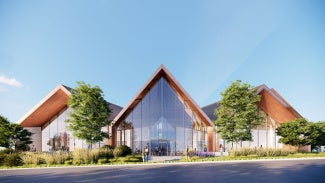
Renderings depict a distinct massing concept. Twelve gabled “houses” form the museum’s square footprint, evoking the area’s residential vernacular. This is further complemented by overhangs, glazed façades, and exposed timber cladding that lend some houses the feeling of a neighbor’s front porch. These houses revolve around a central public courtyard that forms a 12-point star, a symbolic nod to the 12-ray nova star (“new star”) inscribed on the official Juneteenth flag.
Alligood says of the building, “you'll always be able to feel visually connected” from one area to the next. More details come from Derwin Broughton, AIA, the vice president of design at NJM’s architect of record, KAI Enterprises, and Brien Graham, AIA, the firm’s civic, municipal, and cultural market lead. Along the building’s interior, a community hall that envelops the star-shaped courtyard will act as the building’s “central hub, where all programmatic functions overlap,” Graham says. “Eyes are always on the center of the building … it’s the project’s guiding light.”
Building a new chapter
NJM’s programming and location truly set it apart. Rather than just curating a historical window that draws tourists, the building will also be a catalyst for local economic revitalization. It will become a beacon of activity within a culturally important yet underserved community.
“The building is about accessibility,” Graham says. “The desire for the National Juneteenth Museum was for this to be a teaching ground for the neighborhood, as a place for African Americans in Fort Worth to come together.” As examples, Graham highlights the business incubator, which “will educate neighborhood residents about business and finances,” and the food hall, which “will have stalls where local vendors can hone their chops and really elevate their business, and maybe open up a brick-and-mortar location of their own.” He continues: “This isn’t just about the history of Juneteenth. It’s also about business and culture and redefining what wealth generation can look like in this neighborhood.”
That the National Juneteenth Museum is in Fort Worth’s Southside is significant, and it ties back to Opal Lee’s influence. When news of emancipation finally reached Texas in 1865, it was delivered in Galveston, some 300 miles and change to the south. The modern-day movement to raise national awareness of Juneteenth, however, began with Lee, a former elementary school teacher, Southside resident, and Presidential Medal of Freedom recipient. She will turn 100 in October. According to Graham, it was Lee’s efforts and years of advocacy—which included a historic 1,400-mile, 4-month-long walk from Fort Worth to Washington, D.C., in 2016—that “really drove home the desire to have this museum live in the Historic Southside.”
“Seeing the museum moving forward is a dream fulfilled. I’ve had a little Juneteenth Museum in that spot for almost 20 years,” Lee once remarked, referring to a collection of artifacts she maintained in the neighborhood where she grew up. “And to see it become a central place for discussion, collaboration, and learning seems [like] the providential next step.”
Justin R. Wolf is a freelance writer covering architecture and design. He lives in Maine.