
How one firm navigated a large urban project in Rochester, N.Y.
The Neighborhood of Play in Rochester's Inner Loop East was an exercise in juggling multiple stakeholders.
Architects know how to work collaboratively with their clients, but large projects, in particular, require interactions with many layers of AEC professionals, as well as city planners and developers, neighborhood groups, and other stakeholders.
Getting involved early, being proactive, identifying opportunities, nurturing strong relationships, and showing empathy go a long way to creating successful collaborations.
A broader impact
In the 1990s, the city of Rochester, N.Y., started planning an infrastructure project that would involve filling in a mostly sunken, underused circular highway known as the Inner Loop.
CJS Architects, a firm with offices in Buffalo and Rochester, built a relationship with the Strong National Museum of Play in Rochester as the museum worked on an expansion project. CJS principal Craig Jensen, AIA, says his firm saw a chance to help the city in its quest for a more cohesive downtown.
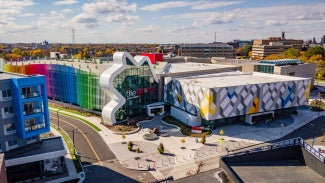
Jensen and his team were able to shift the museum leadership’s focus from “bringing in outside visitors to being an agent of change for the city,” he says. “They began to see they could have a broader impact.” The eventual expanded Neighborhood of Play project, which includes a 90,000-square-foot expansion of the Strong Museum, opened in 2023. It also includes housing, retail, and a hotel, and sits on what used to be the sunken Inner Loop downtown.
From Inner Loop to Neighborhood of Play
The Inner Loop highway was constructed in 1952 at a time when Rochester, N.Y. was home to Eastman Kodak, Xerox, Western Union, Gannett, Bausch and Lomb, and many other large companies. Downtown was crowded with traffic. At the same time, suburbanization and car ownership were increasing.
"The solution was a bypass, a ring road around downtown to prevent cars from driving through the heart of the city," says Erik Frisch, commissioner of the Department of Neighborhood & Business Development for the City of Rochester. In addition, an influx of Black residents was followed by many white residents leaving the area and businesses leaving the city. The Inner Loop never really served its intended function.
By 1990, the city recommended the roadway’s removal to bring it up to grade in its footprint and reconnect downtown with adjacent neighborhoods, Frisch says. Traffic studies had shown that removal was cheaper than maintaining the nearly 40-year-old roadway. In addition, filling it in and developing the newly created parcels would be an opportunity to right the wrongs of its original urban renewal planning that ultimately divided redlined neighborhoods, demolished homes, businesses and houses of worship and cut up two Frederick Law Olmsted-designed parks.
Because CJS had nurtured its relationship with the Strong Museum, the architects were on hand to help the museum apply for funding from Empire State Development and connect the museum with development partners Konar Properties and Indus Hospitality Group. The three entities funded a master plan for the surrounding area.
“When the city finally released the RFP for the Inner Loop parcels, we already had a full concept and funding proposal in place,” Jensen says.
The Inner Loop project has two distinct parts, Inner Loop East and Inner Loop North. The Strong National Museum of Play is situated adjacent to and partially on new parcels created by filling in the Inner Loop East. A redevelopment project focusing on Inner Loop North will begin in 2029.
-
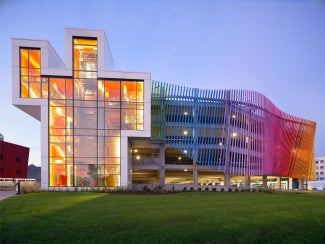 Kim Smith PhotographyStrong National Museum of Play parking structure south entrance, designed by CJS Architects.
 -
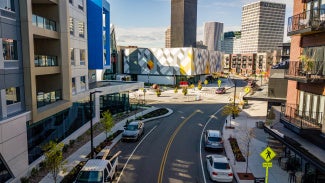 Gary Ledgerwood PhotographyNeighborhood of Play view from the west featuring Hampton Inn & Suites on the left and multifamily building on the right.
 -
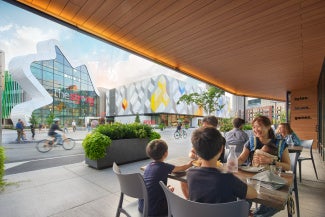 Kim Smith PhotographyNew mixed-use retail and dining sits across the street from the expanded Strong Museum of Play.
 -
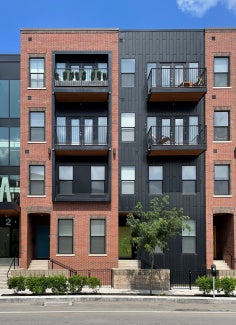 CJS ArchitectsThe exterior of a residential structure within the Neighborhood of Play master plan.




Looking for opportunities vs. waiting for RFPs
Dirk Schneider, AIA, principal at CJS Architects, says the Inner Loop project is a good example of how the firm collaborates to find and follow through on all its projects. “We use the same toolkit of ideas and methods,” which begins, he says, by “not waiting for a city to issue an RFP. We look for opportunities and reach out to developers—hotels, housing, commercial–and put together a team of interested partners.”
He says they have found that if they just respond to RFPs, especially for large-scale master planning jobs dominated by national firms, “You risk creating great ideas detached from what a community really needs. Those often end up on a shelf.”
Schneider says the firm finds opportunities by creating relationships with industrial development agencies, communities, and other clients who “learn how we think.” They often call with queries about land or buildings they don’t know what to do with or ask the firm for help thinking outside the box. “It’s easy when you have a defined program like a school or warehouse, but we like to explore bigger possibilities,” Schneider says. “We effectively create our own RFPs, reach out to cities or developers and start the conversation.”
Having a local connection helps with collaboration, but what’s more important is the ability to build trust. “Some communities, especially those struggling economically, are eager to work with someone who listens and shows empathy,” Schneider says.
And while being proactive can be more difficult when the firm ventures into other parts of the country, it still comes down to “relationships and being genuine,” Schneider says.
The proactive approach does carry some risk, e.g. spending time doing essentially unpaid research and development or marketing. But people remember those conversations and design ideas, Schneider says. “We may not be the ‘shiny new firm’ from L.A. or Chicago, but our reputation for practical community-based design matters," he says. "And you never know when your paths will cross again.”
Full circle
When the Inner Loop was filled in, in 2017, it created an at-grade, complete street, tying neighborhoods back together in many places. CJS’ projects in the new Neighborhood of Play include 250 residential units, a mix of market rate and affordable housing; a mixed-use component with 17,000 square feet of retail; and a Hampton Inn & Suites.
The apartments are fully leased and there’s a waiting list. Current commercial tenants include a Rochester Institute of Technology gallery, a large cafe, a video arcade/restaurant, and a brewery.
Other architecture firms have also been part of redeveloping the area. The multi-disciplinary SWBR worked with the development and construction firm Home Leasing on three residential projects—a market rate building, for-sale townhouses, and a mixed income housing development—and a mixed-use development.
These firms and others have truly transformed downtown Rochester. Says Rob Fornatara, principal at SWBR, “The Inner Loop East project is a great example of persistence. It took over a decade and proved that removing a highway could actually succeed. Rochester has become a national model. The Inner Loop North will build on that momentum, on a larger scale.”
Stacey Freed is a freelance writer focusing on architecture and design. She lives in upstate New York.