
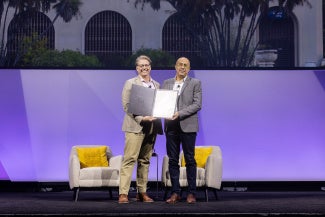
Sameh Wahba on designing a better world
On the final day of AIA26, World Bank sustainable development director Sameh Wahba sat down with AIA 2026 President Illya Azaroff, FAIA.
Sameh Wahba is the regional practice director for the World Bank’s Europe and Central Asia Planet department, where he oversees a $10 billion portfolio spanning agriculture, climate change, environment, and water.
On June 13, Wahba delivered the final keynote address at AIA26. He outlined the World Bank’s focuses—designing for prosperity, resilience, and inclusion—and discussed the role of urban planning in those areas. Later, AIA 2026 President Illya Azaroff, FAIA, joined Wahba onstage for a conversation on how architects and designers can help create a better world.
Designing for prosperity
Wahba’s first topic was designing urban areas for prosperity. Today, about 55% of the world’s population lives in urban areas, but the World Bank projects that by 2050, the figure will climb to about 70%. That translates to adding 2.8 billion people to cities. The growth will largely take place in the Global South.
Urban population booms present a chance to improve people’s economic conditions: “When cities work well, they are an escalator out of poverty,” Wahba said. Cities concentrate many jobs within small areas, which is why “as countries urbanize, poverty declines.”
But growth without careful design creates bad conditions. One issue is housing: Nearly a billion people live in slums today, Wahba pointed out.
Another problem is getting around. Heavy congestion can hamper people’s abilities to reach jobs, even if they live in a city that supposedly has lots of work available. To wit, the World Bank estimates that in Nairobi, Kenya, people who use public transportation in the form of minibuses can reach only 20% of the city’s jobs in an hour or less.
The World Bank is tackling challenging urban conditions in a few ways:
- Introducing integrated planning to cities
- Improving housing and land policy as well as upgrading conditions in slums
- Boosting waste-management capacity and emphasizing nature-based design to reduce pollution
- Investing in public transportation and transit-oriented development to reduce commute times
Designing for resilience
Wahba next brought up designing for resilience, specifically in response to the increasing severity of natural disasters. “Poor people tend to be the most vulnerable,” he said. “They tend to live in the flood-prone areas, the landslide-prone areas.” To counteract worsening disasters, Wahba indicated the World Bank is investing in agroforestry (to strengthen forests), climate-proofing infrastructure (to make structures like bridges more resilient), and expanding water circularity.
Designing for inclusion
The final World Bank focus Wahba discussed was designing for inclusion. To explain what he meant by inclusion, he brought up the examples of cities’ ability to absorb refugees as well as “the dimension of disability, which affects 15% of the global population, and which creates an … imperative for designers in terms of designing for broad range of disabilities.”
Wahba detailed the ways the World Bank is expanding inclusion, citing the organization’s efforts to increase service delivery in rural Egyptian areas and support marginalized people in Kenya. He highlighted a specific slum in Kenya, where adding a single light pole “completely transformed” the area because “businesses can [stay open] later, kids come and sit under the light to complete their homework, and safety improves.”
The role of architects in successful projects
Midway through Wahba’s time onstage, Azaroff joined him and asked him to share some common elements he has observed in successful projects. Wahba named three—design, infrastructure, and finances—and indicated that sequences that start with design in mind work best.
“We have a lot of mayors who have great ideas about what they want to do, but taking that idea to make it into a shovel-ready project” requires quite a process, said Wahba. Especially important is the “pre-feasibility stage,” which involves proving that an idea is possible.
“Is that where [architects] step in?” Azaroff asked. “That seems like the point where architects need to be involved.”
“Exactly,” Wahba replied.
Rebuilding Ukraine
Near the end of the talk, Azaroff, whose family is from Ukraine, asked Wahba what he predicts for the rebuilding of Ukraine following its current conflict with Russia.
“In the World Bank, we’re investing in supporting single-family houses with financial transfers, so that they can rebuild or fix or repair their housing,” Wahba said. “But what do you do with the multifamily, multistory developments? … It’s a big challenge. There’s going to be a major role for designers, planners, and of course the construction industry to intervene in terms of the rebuilding.”
He predicted architects will work “with institutions like national governments, local governments, [and] the communities, because if you don’t harness the power of communities in construction, there’s only so much that can happen.”
Adapting to a changing world
Azaroff’s final question was, “What should we all start to do to help build a more resilient and truly regenerative future?”
“I think focusing on more adaptable solutions, more flexible solutions … is going to become very critical,” Wahba said. To illustrate what he meant, he pointed to a structure in Bangladesh that serves several purposes: It’s a school in normal times, but during a flood, people can use it to seek shelter and safely store their farm animals—which are critical to their livelihoods—thanks to its specialized design.
Wahba also said that much of the Global South is “untouched by designers” before pivoting to an example of what happens when designers do get to intervene: In the 1990s, a team led by architect Jorge Mario Jáuregui undertook the Favela-Bairro Project, which involved upgrading slums in Rio de Janeiro.
According to the Harvard University Graduate School of Design, the project improved the lives of “nearly 450,000 people in 105 shantytowns.” In recognition, Harvard gave Jáuregui the Veronica Rudge Green Prize in Urban Design in 2000. Work like Jáuregui’s illustrates how architects and designers can “do a lot to transform for resilience, for prosperity, and for inclusion,” Wahba said.
Danielle Steger is senior manager, editorial & publications at AIA.