
Governance at AIA
Review the preliminary recommendations of the AIA Governance Task Force—aimed at evolving governance at AIA and strengthening AIA through role clarity, representation, and strategic focus.
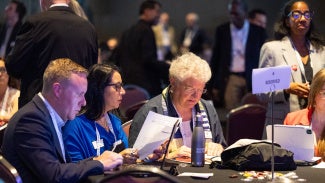
Strengthening how AIA serves its members—today and into the future
The AIA Governance Task Force was established by the AIA Board of Directors to evaluate and strengthen AIA’s governance framework—ensuring it remains clear, effective, transparent, and representative of the members it serves.
Over the past year, the task force has conducted a comprehensive review of AIA’s governance structure, building on prior assessments and engaging with volunteer leaders, components, member groups, and staff across the organization. This work examined how governance functions today and where improvements are needed to better support member voice, decision-making, and accountability.
Why governance evolution matters
As AIA has grown in size and complexity—and as member expectations and the profession itself continue to evolve—our governance structures must evolve as well. This effort is not about changing who AIA is. It is about strengthening how AIA works.
The task force identified consistent themes across AIA, including the need for:
- Clearer roles and decision-making authority
- Stronger, more direct pathways for member voice
- Improved transparency and trust in governance processes
- More efficient, non-duplicative structures that respect volunteer time
What the task force is proposing
Based on these findings, the AIA Governance Task Force has developed a set of preliminary recommendations grounded in governance best practices and focused on positioning AIA for long-term success. The recommendations aim to:
- Clarify the distinct but complementary roles of the board, member representative bodies, and staff
- Strengthen how member perspectives and expertise inform decisions
- Improve communication, accountability, and transparency across governance bodies
- Support a more nimble, inclusive, and strategic AIA
These recommendations are working drafts, intentionally shared early to allow time for dialogue, learning, and refinement.
Review the task force recommendations
Your voice matters
This work is now entering a critical stakeholder engagement phase, and member input is essential. AIA members are encouraged to:
- Review the preliminary recommendations
- Review the February-March town halls
- AIA Governance Town Hall: Monday, February 9 at 2pm ET—watch the recording >
- AIA Governance Town Hall: Tuesday, March 3 at 4pm ET—watch the recording >
- Review the May working sessions
- Download the recordings and view the detailed recommendations >
- Review the AIA Annual Business Meeting presentation from AIA26
- Share feedback online and through other engagement opportunities
Your feedback will directly inform refinements to the recommendations before they return to the board for consideration and potential action.
Together, we can help shape a governance model that supports AIA’s mission, reflects our shared values, and serves the needs of today’s—and tomorrow’s—members.
Your voice matters. Share your feedback and questions with the task force on their preliminary recommendations—anonymously if you prefer—to help shape the future of AIA governance.
Resources & FAQ
Stay informed with monthly updates and explore common questions about the task force’s work and purpose.
AIA Governance Task Force
What is the task force doing?
We're conducting a governance assessment—a comprehensive review of AIA’s governance structure to ensure it supports transparency, communication, and trust across AIA.
Why was the task force formed?
The 2024 AIA membership passed a resolution to study whether the current governance model still meets the needs of the membership and reflects AIA’s diversity.
Who is involved?
The task force includes leaders from various parts of AIA and is supported by AIA staff and an external governance consultant.
Strategic planning
Who will serve as the forward-thinking body for AIA?
The proposed joint Strategic Planning Committee, co-chaired by a member of the Board of Directors and a member of the Strategic Council, creates a collaborative pathway for setting and managing AIA's strategic direction. The committee is intended to be evenly comprised of board members and councilors, ensuring the council has a direct role in shaping strategic priorities. The committee would maintain a regular cadence of longer-range visioning (typically every three years). Between planning cycles, the council, Knowledge Advisory Forum, Knowledge Communities, and other constituency groups would continue to surface emerging trends and work across AIA's bodies to act on priorities.
Will there still be room for council workgroups to pursue topics outside the strategic plan if a need is identified?
Yes. Aligning council work with the strategic plan is meant to ensure the council’s efforts are connected to AIA’s priorities and that the board is positioned to act on them. It is not intended to limit the council’s ability to explore emerging issues or bring forward perspectives not yet reflected in the plan.
Board composition and committees
Would future candidates for the board need to be approved by the Candidate Development Committee (CDC) to run?
No. The CDC does not approve or select candidates. Its revised role is to serve as a proactive leadership development body, working with the component network and constituency groups to build a stronger leadership pipeline within AIA. This group will also help identify competency gaps in the candidate pool and identify training and leadership development opportunities for leaders.
The CDC is designed to be a resource rather than a gatekeeper; its purpose is to expand and strengthen the pool of qualified candidates, not to screen or limit who can run. They will ensure the pool of candidates is representative of the voices sought in the board room – emerging professionals, small firms, large firms, various practice specialties and expertise.
Does the new board committee structure limit the ability to start task forces or board-level committees as new issues arise?
No. The proposed changes streamline existing board committees and provide clearer annual charges, but do not limit the ability to stand up new task forces or committees. In any given year, the president could create a task force or committee, drawing members from across AIA, to address an emerging issue.
Is the Public Director a voting director?
Yes. Currently, the board has two Public Directors with voting rights. In the proposed model, there would be one Public Director, and they would retain voting rights.
In the recommended board restructure, would the president only appoint one ex officio seat?
The president would have one appointed seat: the Public Director. However, this is not an ex officio seat. "Ex officio" means someone is seated by virtue of their title or position. In the proposed model, the only ex officio seat is the EVP/CEO, who serves as a non-voting member, which is unchanged from the current model.
Who is currently eligible to serve on the board, and are those requirements changing?
The Bylaws establish clear eligibility thresholds for board service. The task force is not currently proposing changes to these requirements but welcomes feedback on whether they should be revisited. Currently:
- Architect members must comprise a majority of the board at all times (§6.41).
- No fewer than five at-large directors must be Architect members (§6.044).
- No fewer than two-thirds of the at-large directors elected by the delegates must be Architect members (§6.041).
- No fewer than two-thirds of the at-large directors elected by the council must be Architect members (§6.0422).
- All elected officers must be Architect members (§6.1).
- Associate members are not eligible to serve as national officers (§2.233).
Representation
What is each board member’s responsibility for representing member voices, and how does the proposed model ensure different groups have meaningful representation?
In the proposed model and consistent with modern governance best practices, all board members have a fiduciary duty to act in the best interest of AIA and all its members regardless of how they came to the board. They are expected to maintain ongoing dialogue with AIA's constituencies: listening to member concerns, surfacing those perspectives in deliberations, and ensuring information and decisions flow back in a consistent and timely way. The task force is committed to developing clear expectations for how this engagement works across all director roles.
There are no direct voting seats from state components on the board. Can you clarify the thinking behind this?
The task force believes every board member, not just a designated representative, should be thinking about components and member voices. By reinforcing this through revised roles and communication expectations, the goal is to embed the member's voice throughout the board's work rather than limit it to a single seat.
Has there been consideration of adding board seats for the Small Firm Exchange (SFx) and Large Firm Roundtable (LFRT)?
The task force considered different models and potential seats for constituency groups. These recommendations reflect the desire to maintain the competency-based board model while preserving seats for groups whose voices are valued in board meetings but who otherwise do not have clear pathways to the board. NAC, AIAS, International, and YAF are examples of this. Specific SFx and LFRT seats are not included in the current preliminary recommendations, as practice-type and firm-size diversity will be a primary goal of the Candidate Development Committee, encouraging candidates at-large as well as through the Strategic Council and Knowledge Advisory Forum as pathways for these voices to influence board decision-making.
Strategic Council
If the intent is for the council to no longer be self-governing, how will it be governed?
Today, the council largely manages its own leadership appointments, sets its own priorities, and determines its own work products and timelines. Through the task force's research, we consistently heard that this has led to misalignment between the council's work and AIA's strategic priorities, and to frustration among councilors who do not feel heard or valued. Further, the board has not always been positioned to act on the council's recommendations due to timing or the cadence of decision making.
The proposed changes preserve the council's autonomy in how it executes its work, while creating a clearer framework around it. The intended outcome is to improve alignment with AIA's strategic plan, create greater consistency across leadership transitions, and establish clearer mutual expectations between the board and council regarding communications and the timeliness of responses. The task force is committed to developing the specific operational details in collaboration with the board, council, and staff.
What is the role and mission of the council in the proposed model?
The task force envisions the council as the representative voice of AIA’s components and constituencies at the national level, ensuring the board’s decisions are informed by the breadth of member perspectives and that the council’s work connects to meaningful outcomes for members. Through its workgroups and participation in the joint Strategic Planning Committee, the council also plays a forward-looking role in shaping the AIA’s long-term direction.
How will the council’s annual charge be defined, and by whom?
The intent is to establish a more consistent, transparent, and collaborative process around how the council’s priorities are determined and connected to AIA’s strategic direction. The AIA president-elect and council moderator–elect will get recommendations from the Strategic Planning Committee regarding the priority areas of focus for the council for the coming year. The moderator will continue to have discretion to identify expert individuals for workgroups outside of the councilors to inform their work. The president will continue to have discretion to form a task force or assign a charge to a standing committee if other expertise is necessary.
How do these recommendations address the communication and collaboration challenges members have experienced?
The recommendations address both. The joint Strategic Planning Committee, clearly defined roles and expectations for board members, and a commitment to two-way communication are designed to ensure the council’s work translates into direct, positive impact for AIA’s members and that members and component voices are considered in governance decisions.
How was the work of the Strategic Council's 10-Year Evaluation Study Group represented in the current proposal?
The task force recognizes the significant volunteer effort behind the 10-Year Evaluation Study Group's work and reviewed it closely. Several elements were incorporated into the preliminary recommendations, including the joint Strategic Planning Committee and the preservation of the state-based representative model for the council, both of which were broadly supported in member feedback. The bicameral shared-governance model, in which the council and board would co-share responsibility for decision making and setting the strategic direction of AIA, was not advanced due to concerns that dual decision-making authority would slow the governance process and create confusion about where ultimate accountability lies.
Implementing change
What is the mechanism to approve any changes?
It depends on the type of change:
- Culture and process changes (e.g., communication norms, governance training) do not require a delegate vote and can begin once the board approves.
- Policy changes (e.g., board committee charges, the Knowledge Advisory Forum) require a board vote but not a delegate vote.
- Bylaws changes (e.g., board composition) require a delegate vote at the Annual Business Meeting.
How long will implementation take once changes are approved?
The current plan is to continue stakeholder engagement through spring 2026 and share an informational update at the June 2026 business meeting in San Diego. From there, the Task Force anticipates a transition period with continual learning loops and feedback to ensure any new processes, cultural changes, and structural adjustments are meeting their intended goals.
If structural changes to the board are proposed and adopted in June 2027, the Task Force expects the transition to unfold over approximately three years, as board members and Councilors cycle through their existing terms. This approach is intentional: it preserves institutional knowledge and continuity while the new structure takes shape, and it allows the organization to course-correct based on what is learned along the way.
Will these changes make the organization more financially efficient to a point where we could reduce dues?
The task force has not yet evaluated the financial implications of these changes. Once we gather stakeholder input and make refinements, we will conduct a full financial analysis of the implementation and operational costs. That said, by reducing duplication and better aligning work across governance bodies, the recommendations aim to make AIA more effective in deploying its resources.

Meet the task force
The AIA Governance Task Force includes a diverse group of leaders from AIA chapters, Knowledge Communities, the Strategic Council, and across the broader membership. The group also works in close collaboration with AIA staff and an external governance consultant.
The AIA Governance Task Force was established to study and assess the AIA’s governance structure—how decisions are made, who represents the membership, and whether our current systems meet the needs of today’s architects. Appointed by the AIA Board of Directors, they recommend to the board ways to improve communication, foster trust, and ensure a governance model that reflects the breadth and diversity of the AIA community.
The task force is committed to transparency and welcomes member feedback throughout its work.
Mickey Jacob, FAIA – Chair (Former AIA President)
Leah Alissa Bayer, AIA – Member at-large
Gabriella Bermea, AIA – Member group representative
Susan Chin, FAIA – AIA Knowledge Community representative
Jeffrey Gill, FAIA – Component representation
Anne Hicks Harney, FAIA – Director at-large
Timothy Hawk, FAIA – Past board member
Cheryl McAfee, FAIA – Member at-large
Jessica O’Donnell, FAIA – AIA Strategic Council moderator
Carol Rickard-Brideau, AIA – Member at-large
Anthony Rohr, FAIA – Member at-large
Nicki Dennis Stephens – Component representation
Darral Tate, AIA – SAC, YAF & NAC representative
Curt Wilson, AIA – Member at-large
Heather Wilson – Component representation
Susan Wyeth, AIA – Resolution sponsor
Carole Wedge, FAIA – EVP/CEO (Ex Officio)