
New ABI White Paper: Clarifying the Construction Outlook by Integrating Architecture Billings with Broader Economic Indicators
The white paper examines how architecture firms and the broader AEC industry use the ABI and related indicators to assess current market conditions and forecast future building activity.

WASHINGTON –November 4, 2026 – The American Institute of Architects (AIA) has published, Clarifying the Construction Outlook by Integrating Architecture Billings with Broader Economic Indicators, a white paper examining the performance of the AIA/Deltek Architecture Billings Index® (ABI).
Amid economic uncertainty, the white paper examines how architecture firms and the broader AEC industry use the ABI and related indicators to assess current market conditions and forecast future building activity. The analysis also updates the relationship between the ABI and construction spending, finding a slightly weaker correlation but a longer lead time due to extended project schedules driven by supply chain challenges, cost inflation, interest rate volatility, and economic uncertainty.
The white paper highlights the industry's reliance on a range of economic and construction indicators, including the ABI, construction spending and starts, building material costs, real estate trends, and AIA's Consensus Construction Forecast, to guide planning and investment decisions.
AIA launched the ABI in 2005 as a leading indicator of construction activity, documenting the relationship between architecture firm billings and subsequent construction spending. Because design activity precedes construction, the broader building industry relies on ABI data for planning, as architecture firms are often the earliest comprehensive source of information on proposed development projects. In 2014, AIA updated its analysis in Designing the Construction Future, introducing design contracts as a new leading indicator of future billings and refining the relationship between design activity and construction spending to reflect the impacts of the Global Financial Crisis.
Since the last analysis, several economic events have influenced the timing and strength of the relationship between design activity and construction, including the slow recovery of the nonresidential building sector following the Global Financial Crisis, disruptions caused by the pandemic, and recent economic and political uncertainty that has complicated development and construction planning decisions.
Complete our form to submit a press inquiry or speaking request.
Follow AIA on LinkedIn.
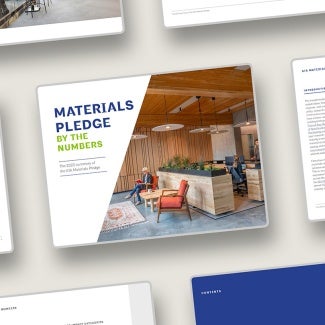
In its third year of reporting, the Materials Pledge continued to gain momentum, with participation growing across the profession and signatories reaching a record high in 2025.

