

3 Ways firms can respond when construction administration risks running over budget
It’s inevitable that projects will run long and workloads will change. AIA partner Part3 shows how more clarity can help architects gain better control over the economics of construction administration.
Construction administration (CA) has a profitability problem most architecture firms know well: The CA fee is established before construction begins, based on assumptions about the project, anticipated workload, and construction schedule. Then the project changes. An 18-month schedule becomes 24 months. Submittal volume comes in higher than expected. RFIs keep coming. Site visits and meetings continue. Consultants still need coordination.
There isn’t one solution. But conversations with architecture firms point to three ways teams are getting more control over the economics of CA.
1. Know when the project has outgrown the fee
A project running longer than expected doesn’t automatically mean more compensation for the architect. But it should prompt a review of whether the scope the firm originally priced still reflects the work being performed.
Even projects that finish reasonably close to schedule can still generate far more CA work than anticipated. Why? Submittal or RFI volume may be substantially higher. Additional site visits may be required. Changes may create coordination work the original fee didn’t take into account.
Most experienced architects know their agreements provide mechanisms for additional services, but asking for those fees is often not straightforward. Given how architecture is a highly relationship-driven business, firms want repeat clients. This in turn means they want to be reasonable when projects encounter normal construction challenges. Adding to that is the complicating factor of responsibility not being neatly attributable to one party when schedules slip.
The bigger problem is discovering the overrun after the fee has already been spent. Tracking the assumptions behind the fee throughout construction gives firms an earlier signal. That means taking actions like comparing anticipated and actual submittal and RFI volumes, tracking site visits, and watching construction duration alongside fee consumed.
If half the construction schedule has elapsed but most of the anticipated submittals have already arrived, that’s worth knowing early rather than at closeout. It doesn’t automatically trigger an additional services request, but it can give the firm an opportunity to review the remaining fee, staffing, and expected workload while there are still options.
2. Reduce the administrative work consuming the fee
Not every CA profitability problem comes from a change in scope. Sometimes the existing fee is being consumed by work that doesn’t require an architect’s expertise.
At BRW Architects, Construction Administrator George Fahim described the processing surrounding a typical submittal: downloading it, logging it, distributing it to consultants, following up, downloading it again, and updating the log before and after technical review. “There's a lot of time in logging and distribution that doesn’t get accounted for in construction administration,” Fahim says.
BRW focused on reducing that administrative work while keeping professional review with the architect. Fahim estimates that eliminating repetitive downloading, logging, distributing, and tracking can save 20% to 50% of his CA time, depending on project workload.
LM-ESP Architectural Group has seen a similar effect. The firm’s CA support staff previously maintained spreadsheets, updated logs, created hyperlinks, tracked document distribution, and manually followed up on outstanding items. After streamlining those workflows, the firm estimates its CA support staff save approximately 10% to 15% of their time each week.
Those hours translate to increased capacity. “That adds up,” says LM-ESP Associate Michael Sagriff. “Across multiple projects, you can take on another project or two and still manage your time without sacrificing work-life balance or relying on overtime just to keep up.”
For firms looking at CA profitability, recovering additional fees is only one lever. Getting more professional value from the fee you’re already earning matters too.
Gallery: Construction administration software in action
-
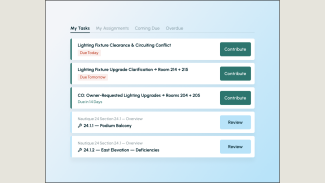 Make collaboration seamless by assigning the right team members to each document or workflow.
 -
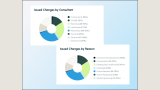
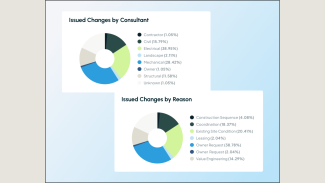 See which consultant groups are issuing the most changes, why the changes are being issued, and how they’ve impacted your project deadlines and financials.
 -
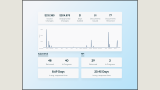
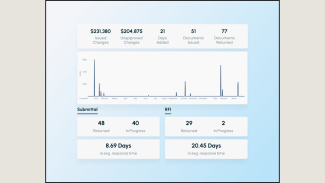 Keep your projects on track during the construction administration phase with instant insights into team performance, cycle times, and project financials.
3. See the problem early enough to act
Better visibility also changes when firm leaders can respond. Sagriff oversees multiple projects and supports other contract administrators at LM-ESP. Having a consolidated view of project activity lets him see “where projects are struggling, where they’re succeeding, and where we might need more resources.”
That can turn CA data into a management tool. Instead of waiting for timesheets to show that a project is underwater, firms can look at outstanding work, deadlines, workload, and project activity while construction is underway.
Gustavson Wylie Architects has taken a similar approach at the project level. Associate Cameron Evans starts his mornings by reviewing outstanding actions, consultant responses, deadlines, and updated documents across his active projects. He estimates he can complete that daily due diligence on each project in five or 10 minutes.
Earlier visibility gives firms more choices. That might mean discussing additional services with the owner. It might mean shifting resources between projects or addressing an inefficient internal process. Or the firm may deliberately decide to absorb additional effort because the client relationship warrants it. The difference is that it’s a decision rather than a surprise at the end of the project.
Better information creates more options
No fee structure can make construction predictable. Projects will run long, workloads will change, and architects will continue making reasonable accommodations when projects get complicated.
But firms can get clarity about the parts they can control: knowing what assumptions went into the fee, recognizing when the work has moved beyond them, and understanding where CA time is actually going.
The goal isn’t to turn every additional RFI, submittal, or month of construction into an additional fee. It’s to recognize when the project you’re administering is no longer the project you priced—and have enough information to decide what to do about it.
See how architecture firms are reducing administrative work and creating more capacity for CA at Part3.io.
AIA does not sponsor or endorse any enterprise, whether public or private, operated for profit. Further, no AIA officer, director, committee member, or employee, or any of its component organizations in his or her official capacity, is permitted to approve, sponsor, endorse, or do anything that may be deemed or construed to be an approval, sponsorship, or endorsement of any material of construction or any method or manner of handling, using, distributing, or dealing in any material or product.