
5 Design ideas from award-winning urban spaces
This year’s AIA Regional & Urban Design Award recipients illuminate creative approaches for environmental and social well-being.
Spring and summer are when public spaces get stress tested. In many regions, people start using parks, waterfronts, and civic plazas more regularly. The warmer months are an opportunity for architects and designers to identify what’s working and what isn’t in places they help create.
It’s fitting, then, that this is the time of year AIA announces the Regional & Urban Design Award winners. These awards recognize multidisciplinary teams shaping how people move, gather, and experience their cities. The 2026 winning projects provide the following ideas for designers who want to positively influence environmental and social well-being in communities.
Downtown Cary Park: Integrated design helps civic identity flourish
Downtown Cary Park in Cary, N.C., showcases the power of combining landscape and architectural design to create public spaces people will regularly enjoy. With winding paths, gardens, and distinctive buildings such as the Great Lawn Pavilion, Bark Bar, and Academy Pavilion, the park anchors the city’s vibrant downtown with a series of “outdoor rooms” for recreation, respite, and small and large gatherings.
The design encourages movement and repeat visitation with architecture and landscape design that operate as a unified system. It supports a flourishing day-in, day-out civic life and reinforces Cary’s commitment to consistent, accessible public experiences. The park was the result of a broad team effort, including contributions from Machado Silvetti, OJB, Lam Partners, RSM, Simpson Gumpertz & Heger, Cosentini, Withers Ravenel, Balfour Beatty, Irrigation Consulting Inc., and Fluidity Design Consultants.
Learn more about the project here.
India Basin Waterfront Park: Ecological restoration can coexist with adaptive reuse and new construction
India Basin Waterfront Park in the Bayview–Hunters Point area of San Francisco demonstrates how environmental repair strategies, adaptive reuse, and new construction can collectively work to create a resilient community hub. The project’s restored shoreline and upland habitats form an ecological backbone and are intentionally interwoven with built interventions: a preserved and rehabilitated Shipwright’s Cottage, new high-performance public amenity buildings, floating docks, and piers designed to adapt to sea‑level rise. Driven by an equitable development plan, India Basin Waterfront Park is a place where ecological systems, historic structures, and contemporary architecture complement one another and improve access to natural resources. This integrated approach reflects a collaboration between GGN, Jensen Architects, Page & Turnbull, and several local institutions.
Learn more about the project here.
The Innovation Ecosystem: Mixed‑use academic districts can boost urban life beyond campus boundaries
Located in Monterrey, Mexico, Monterrey Tec’s Innovation Ecosystem illustrates how universities create more urban and civic connections when they design for permeability rather than isolation. By integrating labs, offices, housing, and community spaces within a network of public greenways and plazas, the district functions as a unifying neighborhood rather than a campus enclave.
Academic and entrepreneurial activity at the site is integrated with the city’s daily rhythms, strengthening ties and opportunities for innovation between the institution and the broader community. Sasaki’s design represents a growing trend that indicates higher education districts can support economic development and social vitality when they embrace principles of urbanism.
Learn more about the project here.


The Bay: Site‑specific design bonds places and communities
Designed with the mantra “One Park for All,” the first phase of The Bay in Sarasota, Fla., shows how site‑specific design can be essential for local investment and longevity. Guided by extensive community input, the project draws directly from Sarasota’s cultural and ecological characteristics, including coastal lifestyles, Modernist design traditions, and mangrove habitats.
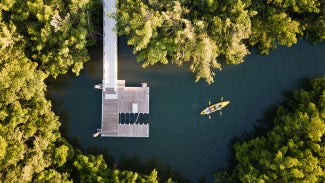
Restored natural resources, rain gardens, and denitrification systems transformed a former parking lot into a functioning landscape, and new amenities like the Mangrove Walk, beach, kayak launch, performance lawn, and The Nest pavilion offer a distinctly Sarasota experience for community members and visitors. The Bay’s design, by Agency Landscape + Planning and Sweet Sparkman, grounds the first phase of the park in local identity.
Learn more about the project here.
Waterfront Park: Infrastructure change can drive multi‑scalar public realm transformation
Seattle’s Waterfront Park demonstrates multi‑scalar design’s potential to reconnect a city to its waterfront after major infrastructure change. The 2019 removal of the Alaskan Way Viaduct and subsequent reconstruction of the Elliott Bay Seawall opened the door for a comprehensive and integrated public realm design. Restored habitats and gardens display native features, while a 1.2‑mile protected bike path and new east‑west streets offer multimodal access.
Overlook Walk, Pier 62, and reimagined historic piers establish connections between downtown and Elliott Bay and provide needed public recreation spaces. Field Operations and Jacobs led the design effort, positioning the waterfront as a resilient asset for Seattle’s future.
Learn more about the project here.
Design excellence in the urban realm
These award-winning projects reflect the value of inclusive public spaces that are resilient and rooted in the everyday experiences of the people who use them. Cities are continuing to weather complex economic conditions and adapt to environmental, social, and infrastructural change. The work of architects, landscape architects, urban designers, and their many collaborators offer inspirational direction for how design can support a more regenerative urban future.
Kathleen M. O'Donnell is a freelance writer, editor, and communications strategist based in Washington, D.C. She is committed to telling stories that provide useful insights to architects and designers and highlight the impact of their work.