
Speaking the same language in structures
AIA partner AISC shows how a design-assist approach can resolve challenges and protect the architect’s vision on ambitious projects like the Las Vegas Sphere and San Diego Airport Terminal 1.
A beam no longer fits within the allowed plenum depth. Tolerances or erection sequencing make a detail behave unpredictably. Budgets tighten. Timelines compress.
We have all felt the moment when a clear architectural vision begins to blur under the weight of practical constraints. Most architectural projects begin with a sketch or concept—a spatial idea that suggests how people will move, gather, pause, and experience a space. As the project advances, however, the forces shaping that vision often begin to diverge. Changing this pattern requires not a single solution but a shift in how teams communicate and when they begin those conversations.
Collaboration brings the Sphere’s exoskeleton to life
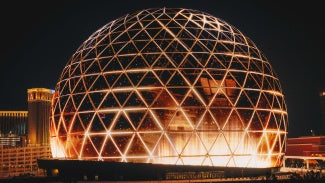
Consider the monumental challenge of the Sphere in Las Vegas. Creating the world’s largest spherical structure required an exosphere of massive proportions and precision.
On a project of this complexity, the natural impulse might be to finalize the architectural intent before involving consultants or contractors, fearing that doing so might stifle the creative process. However, the project team realized that the only way to realize such an ambitious form was to integrate the “how” with the “why” almost immediately.
By engaging in a design-assist approach, the architects and structural team used shared digital models to resolve the complex intersections of the steel exosphere long before a single piece of steel was fabricated. This wasn’t about compromising the aesthetic; it was about ensuring the geometry was buildable, protecting the architect’s vision from the cost-cutting and simplification that sometimes plague complex projects in later phases.
On structural steel projects, engineers and fabricators often recognize challenges in the framing long before they appear on a drawing set. If these partners are involved while the design is still fluid, those hurdles can be reframed as design opportunities. Consider the following problems and the benefits collaboration might bring while solving them.
- Difficult spans: Engineers and fabricators may suggest a lighter, more elegant system.
- Complex forms: Collaborators can point you toward modular assemblies that preserve the original profile.
- Tight schedules: Your team can help you benefit from connection strategies that simplify erection and reduce field labor.
Early conversations lead to dramatic cost savings in San Diego
The redevelopment of San Diego International Airport Terminal 1 (SAN T1) faced a daunting mandate to build a sustainable terminal with a 100-year service life while maintaining operations at the busiest single-runway airport in the country. In such a high-pressure environment, the temptation to stick to traditional, siloed workflows is strong.
The breakthrough for the SAN T1 team came when they invited structural designers and steel fabricators into the conversation while the design was still fluid. This collaboration enabled the use of an innovative seismic system featuring buckling-restrained braced frames and preassembled modular roof trusses.
Because the fabricator could weigh in on constructability during the design phase, the team realized $100 million in savings. These weren’t just administrative gains; they were resources that allowed the original architectural intent to remain intact rather than facing erosion from change orders and schedule delays.
Their collaboration paid off in other ways, too. SAN T1 was one of just six projects nationwide to earn the structural steel industry’s highest design honor in 2026: the American Institute of Steel Construction’s IDEAS Award for Excellence in Constructability.
-
 Gensler + Ema Peter PhotographySan Diego Airport Terminal 1, exterior.
 -
 Kirk Hostetter PhotographyInterior space at San Diego Airport Terminal 1.
 -
 Severud AssociatesThe Las Vegas Sphere.


Speaking the same language
Communication style matters as much as content. Architects often think visually, while engineers and fabricators may communicate through calculations and constraints. When these languages do not meet, misunderstandings grow.
Diagrams, quick sketches, and simple models often convey intent more clearly than pages of technical explanation. One of the most effective ways to establish this shared understanding is through early design charrettes. These sessions create space to explore ideas collaboratively, test assumptions, and align on priorities before teams solidify decisions. Just as importantly, they build trust. By the time challenges arise later in the project, the team is navigating them as collaborators rather than strangers.
Strong teams build better buildings
As architects, we are the primary stewards of the spatial experience. But when we remain separated from the people who detail, produce, and assemble the frame until the construction documents are set, we miss the opportunity to use their expertise as a creative catalyst.
This collaborative framework is a proven strategy for maintaining project control, a philosophy reflected in Design Assist: Collaborative Design Approach Guidelines for the Fabricated Structural Steel Industry, a free resource published by AIA Contract Documents and the American Institute of Steel Construction (AISC). It reinforces what both the Sphere and SAN T1: When collaboration begins early, projects are better positioned to succeed.
Your next step
On your next structural steel project, challenge the traditional handoff. Invite your engineer and fabricator into the conversation while your sketches are still fluid. Share your design intent, the feeling of the space, and the logic of the form—not just the dimensions.
By starting the conversation early, you can ensure your vision survives the journey from the screen to the site.
Learn how to incorporate design-assist into your process by downloading AISC’s Design Assist: Collaborative Design Approach Guidelines for the Fabricated Structural Steel Industry.
AIA does not sponsor or endorse any enterprise, whether public or private, operated for profit. Further, no AIA officer, director, committee member, or employee, or any of its component organizations in his or her official capacity, is permitted to approve, sponsor, endorse, or do anything that may be deemed or construed to be an approval, sponsorship, or endorsement of any material of construction or any method or manner of handling, using, distributing, or dealing in any material or product.