
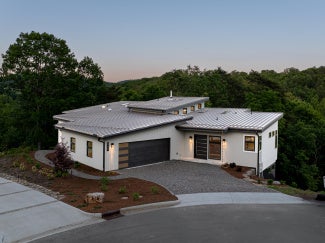
Uniting sustainable design and treetop living in Asheville
Complex programming, aging-in-place and high standards for energy efficiency were table stakes in this project by Form and Function Architecture in Asheville, North Carolina. AIA partner Andersen offers a tour.
“They wanted to be in the trees.”
This was one of the first requests clients made to Emili McMakin, AIA, principal architect at Form and Function Architecture in Asheville, North Carolina. But it wasn’t the only one. They wanted to age in place and to have an in-home glassmaking studio, and they were building in an eco-conscious neighborhood with HOA requirements.
And that’s where the programming began for Broad Vista Retreat.
Find out how McMakin integrated clever design, sustainable strategies, and wise fenestration choices to create a home that fit the program and satisfied the HOA.
Smart separation enables an in-house studio
Building on a slope is hardly notable in Asheville, but the inclusion of the studio was a curveball. The couple wanted main-floor living to accommodate aging in place, which meant the studio was best located in the basement. After several different design iterations, the team landed on a residential elevator from the garage. With an accessible location identified, the next challenge became planning the space without negatively affecting energy efficiency and air quality in the rest of the home.
The studio includes a kiln and a noisy glass grinder. In addition, the neighborhood has a square footage maximum that the house was quickly approaching. The solution turned out to be separation: The studio has its own ventilation system to protect the air quality and thermal comfort of the rest of the home, and its walls were insulated and built more like exterior walls, including extra soundproofing. Essentially, the space was treated more like a garage than an interior room, which also helped work around the square footage issue.
Passive principles enabled by windows
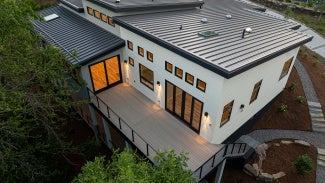
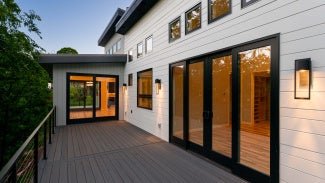
A deep pocket is how McMakin describes the lot. To deliver on her clients’ wish to live among the trees, she designed a low-slung home that presents discretely at the front but opens itself to views and sunlight at the back. There, expansive Andersen E-Series windows and doors create the treehouse effect and frame views of the French Broad River. The E-Series Gliding Patio Doors also allow easy access to the two levels of decks outside for seamless indoor/outdoor living.
All this glass also plays into the passive design strategy. The fenestration was designed in accordance with solar studies to maximize passive solar heat gain in the winter and limit it during the summer with deep overhangs. A vaulted ceiling in the open-concept living space includes clerestory windows, which funnel natural light deep into the space while avoiding solar glare.
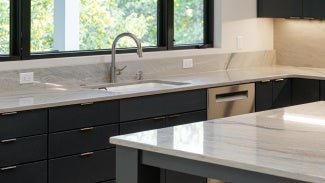
One thoughtful feature is an outdoor skylight built into the roof of the screened porch. The depth of the porch would have blocked direct light from the kitchen directly behind it. “We made the skylight the exact same size as the kitchen window, so they line up and let light in,” McMakin said.
Designing for efficiency
Complementing the daylighting strategy is a geothermal heat pump and advanced construction techniques, which help the home operate efficiently. Red Tree Builders-Alair, the high-performance construction firm behind the project, used advanced wall framing and precast concrete in the basement to improve the building envelope.
Brandon Bryant, president and partner of Red Tree Builders-Alair, said Andersen E-Series Gliding Patio Doors and windows were the perfect choice for the home. Not only did they meet the HOA requirement for aluminum-clad windows, but they also provide the airtight performance needed. The home achieved an impressive HERS score of 43 and a Department of Energy Zero Energy Ready certification.
Find out more about Andersen’s E-Series product line and explore more resources that make specifying easy.
AIA does not sponsor or endorse any enterprise, whether public or private, operated for profit. Further, no AIA officer, director, committee member, or employee, or any of its component organizations in his or her official capacity, is permitted to approve, sponsor, endorse, or do anything that may be deemed or construed to be an approval, sponsorship, or endorsement of any material of construction or any method or manner of handling, using, distributing, or dealing in any material or product.