
Want a healthier firm culture? Start with these 5 steps
Firm leaders reveal their tips for more inclusive workplaces.
Healthy firm cultures don’t rely on perfectly crafted mission statements or instant, sweeping transformations. Instead, they rely on much smaller steps—ones your firm can start taking today. Emily Grandstaff-Rice, FAIA, puts it this way: “Firm cultures don’t happen overnight. They develop over time, and they develop through norms, practice, and rituals.”
To learn more about the behaviors that build strong cultures, AIA talked to Grandstaff-Rice, a former AIA president who played a key role in the creation of AIA’s Guides for Equitable Practice, as well as other established architects who are leaders or core contributors at their firms.
Emphasize openness and “normalize questions”
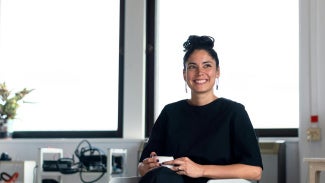
Gloria Kloter, AIA, is the founder of Glow Architects and a recipient of the 2025 AIA Young Architects Award. When fostering Glow’s culture, she at first focused on perfection, but she “underestimated how much emotional intelligence, communication, and transparency can shape the team’s experience,” she says. “If you have team members that feel supported and heard … they show up fully, and it just elevates everything.”
Kloter uses the example of immigrant architects like herself, who “can feel a lot of pressure that we are supposed to know everything.” Likewise, early career employees may feel imposter syndrome, compounded by a fear that asking a question will make them seem unknowledgeable.
Kloter, therefore, encourages firm leaders to “normalize questions, provide constructive feedback, and explain why things are the way they are.” One way Glow handles this is by holding 1:1 meetings during which managers keep the focus away from projects and instead on how their direct report is doing as an individual.
After she pivoted from seeking perfection to consistently promoting openness, Kloter started seeing a change in her firm’s culture. She recalls “a moment when one of our team members said they felt safe to speak openly about some struggles they were going through on a personal and professional level. ... They didn’t [fear consequences] for expressing themselves. That was a moment where I felt like we were doing something right.”
View growth as a boon, not an obstacle
Employee development is so helpful to a firm’s culture that AIA’s Guides for Equitable Practice devote a chapter to mentorship and sponsorship and another to career advancement. And Bill Turner, AIA, says it is a big part of the successful culture at Valerio Dewalt Train (VDT), a finalist for Architizer’s 2024 Best Large Firm Award.
Now a principal at VDT and a member of AIA San Francisco’s architectural licensing committee, Turner says mentorship was critical earlier in his career, particularly when a more experienced colleague encouraged him to get licensed rather than waffle on it. After experimenting with different mentorship models, VDT has adopted an informal process in which the firm’s principals and senior leadership connect with earlier-career employees to offer advice and support. Turner is an enthusiastic participant, now as a mentor rather than a mentee.
VDT also helps employees seeking licensure by covering study materials and testing fees, and they offer schedule flexibility for test takers. Importantly, the firm sets aside time to celebrate employees when they become licensed. Turner says that “shows that we’re there to support them because [getting licensed] is stressful. It’s hard.” He thinks VDT’s efforts help employee recruitment and retention.
Firms can embrace employees’ growth outside of work, too. Take new parents: While some may assume having a child will draw an employee’s focus away from work, Kloter points out that parenthood can increase a person’s “emotional intelligence and adaptability and problem-solving skills,” all of which are extremely useful at work. To make the most of this type of growth, Kloter encourages firms to treat parents with “flexibility and respect” rather than sidelining them after a child arrives.
Add context to improve communication
Amaya Labrador, AIA, is on AIA’s Strategic Council and is one of six employees at human eXperience, a firm focused on behavioral health architecture. Though all of the firm’s employees work remotely, Labrador describes it as “a very collaborative and mutually supportive environment.”
A large part of that comes from the firm’s considerate communication practices. Labrador recommends starting from “a place of grace” and taking “a couple of extra seconds to provide some background on your requests.” Consider the following three messages:
- “Can you send the university window specs?”
- “Hey, have you thought about the window specifications for the university project? Not urgent, but I’ll need them in two weeks for a client meeting.”
- “Please send uni window specs ASAP—I’m on-site with client.”
All three ask for similar information, but the latter two have much more context for the recipient, helping them know why the requester wants the info and whether something needs immediate attention. The latter two examples also reflect Kloter’s suggestion of explaining “why things are the way they are,” and they show the recipient how their answer will contribute to the firm’s work.
Adopt collaboration norms that suit your firm
Every person AIA interviewed for this article mentioned collaboration as key for a healthy firm culture. But different firms have different collaborative practices that work for each.
After the pandemic, Turner says VDT went through a trial-and-error phase during which they held meetings of different sizes, trying to find one that made employees feel connected and listened to. The firm found that while large town halls and dedicated 1:1s still have their place, small roundtable meetings unlocked a new level of collaboration and communication.
Another approach: At human eXperience, “not all communication has to be productive,” Labrador says. One of the firm’s norms is that employees don’t view small talk at the start of each meeting as wasted time.
Instead, Labrador says non-work-related questions like “How’d your event go last night?” help the geographically scattered team stay connected. Because the employees know each other as people, supporting each other during projects feels automatic.
Find ways to measure progress
If you want to improve a firm’s culture, measuring progress is important because, as Grandstaff-Rice says, “You can’t change what you can’t measure.” She recommends choosing specific outcomes to pay attention to. “Your goal could be financial, or your goal could be [improving] team dynamics, or your goal could be producing more design solutions for the client to react to.”
A successful model for measuring culture comes from DLR Group, says Ignacio Reyes, FAIA, the firm’s chief development officer. DLR performs an annual culture-index survey with an impressive response rate of 90%. Reyes says the survey’s anonymity, brevity, and non-cumbersome nature—respondents can keep their answers short if they wish—contribute to the high engagement.
And employees see the firm respond to their feedback, so they know it’s worth their time to participate. “We go through all this stuff very carefully. We take it to heart. We really want to make this the best place,” Reyes says. For instance, the firm recently organized an outing to Bainbridge Island to focus on growing specific skills employees expressed interest in via the survey.
Other signs of progress will reveal themselves in firms’ day-to-day work. To Turner, progress shows up at “the post-project celebration with the [general contractor], the client team, and the designers. ... It’s getting together to celebrate the work of everybody connecting and collaborating as a broader team.”
Get started: Free culture-building resources
AIA’s Guides for Equitable Practice are a free resource consisting of tools for developing equitable, diverse, and inclusive firm cultures and work environments. They take some inspiration from the Parlour Guides to Equitable Practice, which are also free.
Danielle Steger is AIA’s senior manager, editorial & publications.