ABI August 2026: Architecture firm billings continue to decline
Nearly half of architecture firms are actively engaging with AI.

Architecture firm billings continued to decline in August
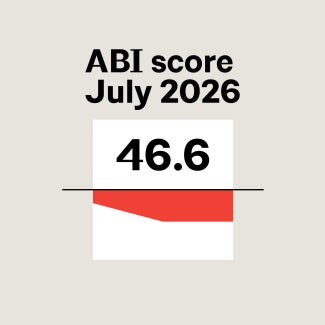
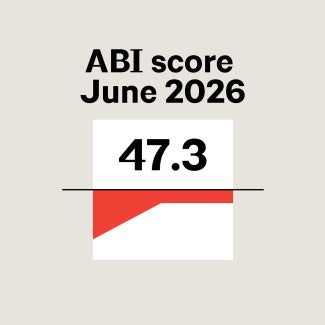
The AIA/Deltek Architecture Billings Index ® (ABI) score for the month was 47.2. While slightly fewer firms reported a decline in billings in August than in July, the majority of firms continued to see weak business conditions. In addition, inquiries into new projects showed only modest growth this month, while the value of newly signed design contracts continued to decline. And sentiment about future billings has weakened at architecture firms as well. When we first asked this new question at the end of the first quarter, 31% of responding firm leaders indicated that they expected billings to increase in the second quarter. That basically held steady at 30% when asked about the third quarter, but has now fallen to 25% when asked about expectations for the fourth quarter. Additionally, the share of responding firm leaders who expect billings to decline in the coming quarter has increased from 21% at the end of the first quarter to 29% at the end of the third quarter.
Despite billings declining overall, firms in some regions saw better conditions in August. Firms located in the Midwest reported modest growth for the first time in nearly a year, while billings were essentially flat at firms located in the West. However, billings softened significantly at firms located in the Northeast, reaching their lowest level since 2020. Billings also varied significantly by firm specialization, as firms with a commercial/industrial specialization saw a slight uptick in August. However, business conditions remained soft at firms of all other specializations, despite firms with institutional and multifamily residential specializations seeing slight growth earlier this year.
Economic crosswinds intensify
Conditions in the broader economy remained mixed in August. Nonfarm payroll employment grew more significantly than had been anticipated, adding 162,000 new jobs in August. Architectural services employment increased as well, adding 700 new positions in July (the most current data available). Despite this employment growth, inflation ticked back up in August, with the Consumer Price Index (CPI) increasing by 0.4% from July, after rising just 0.1% the previous month. It remains up by 3.4% from one year ago, with recent increases in gasoline and energy prices among the largest contributors. Gasoline prices increased by 3.9% in August and are up by a whopping 27.4% from one year ago. As a result of higher inflation and healthier-than-expected employment, the Federal Reserve chose to raise interest rates by a quarter point at its September meeting. This is their first rate increase in three years, and their hope is that this will finally start to bring inflation down to their target rate of 2%.
AI adoption gains momentum
This month’s special practice questions asked firm leaders about their adoption of and investment in AI technology. Overall, nearly half of responding firm leaders (48%) indicated that they are currently engaging with AI at their firm, with 18% reporting that it is a strategic priority and 30% reporting that their firm is actively using AI and modeling the behavior. An additional 34% reported that their firm’s current approach to AI adoption is interested but reactive, while 15% said that their approach is currently passive/cautious. Large firms with annual billings of more than $5 million were significantly more likely than smaller firms to report actively engaging with AI, with 30% indicating that it is a strategic priority at their firm.
Despite this, most firms are not currently providing AI training to their staff. Just 7% of responding firms overall have a formal AI training program, while 26% provide AI training by individual demand. While formal programs are relatively uncommon even at large firms (just 12% have one), large firms are much more likely to provide AI training by individual demand, with 43% currently offering it.
At firms that are currently using AI, slightly more than one in five (22%) report that it has substantially increased their firm’s productivity so far. Just 2% indicate that it has decreased their productivity, while the remaining 76% say that productivity has remained about the same. In addition, just 15% of responding firm leaders reported having a budget allocated specifically for AI this year, while 47% indicated that they do not have a dedicated budget, but instead purchase AI/emerging technologies from other budget lines, and the remaining 38% reported that they do not invest currently in AI/emerging technology. Large firms with an annual budget of more than $5 million were significantly more likely to report having a dedicated budget for AI, with 30% having one, in contrast to 1% of small firms with annual budgets of less than $1 million, and 9% of firms with annual budgets of $1 to $5 million. And overall, two-thirds of firms expect to make a higher investment in AI in 2027, which increases to 84% of firms that already have a dedicated AI budget and 75% of firms that purchase AI/emerging technologies from other budget lines, in contrast to 41% of firms that do not currently invest in AI/emerging technology.
- Join us for FREE at the next AIAU live webinar, Economic Update: Q4 2026 ABI Insights, on October 21, 2026, at 2pm ET.
-
 AIAThe AIA/Deltek Architecture Billings Index® (ABI) is a diffusion index derived from the monthly Work-on-the-Boards survey, conducted by the AIA Economics & Market Research Group. The ABI serves as a leading economic indicator that leads nonresidential construction activity by approximately 9-12 months. The survey panel asks participants whether their billings increased, decreased, or stayed the same in the month that just ended. According to the proportion of respondents choosing each option, a score is generated, which represents an index value for each month. An index score of 50 represents no change in firm billings from the previous month, a score above 50 indicates an increase in firm billings from the previous month, and a score below 50 indicates a decline in firm billings from the previous month.
 -
 AIAGraphs represent data from August 2025–August 2026.
 -
 AIAGraphs represent data from August 2025–August 2026 across the four regions. 50 represents the diffusion center. A score of 50 equals no change from the previous month. Above 50 shows increase; Below 50 shows decrease. 3-month moving average.
 -
 AIAGraphs represent data from August 2025–August 2026 across the three sectors. 50 represents the diffusion center. A score of 50 equals no change from the previous month. Above 50 shows increase; Below 50 shows decrease. 3-month moving average.
 -
 AIAPercentage of firms, expected budget allocation to AI change for 2027.


This month, Work-on-the-Boards participants are saying:
- “Contractors are openly saying that the market is soft. So far, we have remained busy with repeat clients, but have questions for the months ahead.”—23-person firm in the Midwest, mixed specialization
- “The market is still very robust (2022 level for us), but there is also a concern that the overall economy is soft, so it could change with little advanced warning.”—65-person firm in the South, commercial/industrial specialization
- “Lots of low-margin work. Not enough profitable work.”—26-person firm in the West, institutional specialization
- “Issues with permitting stagnate projects, and uncertainty for the future limits economic growth”—2-person firm in the Northeast, multifamily residential specialization
Join the ABI Work-on-the-Boards panel to participate in our monthly survey. Open to architecture firm owners, principals, and partners. All participants get a free ABI subscription.
The monthly AIA/Deltek Architecture Billings Index is a leading economic indicator for nonresidential construction activity.
Deltek is the home of AIA MasterSpec®, powered by Deltek Specpoint. Deltek helps A&E firms boost efficiencies while improving collaboration and accuracy.

Build an AI-ready architecture firm with a practical, step-by-step interactive resource for adopting AI responsibly.