ABI June 2026: Billings remain weak at architecture firms
Nearly half of firms have worked on projects that have characteristics of resilient design over the past five years.

Business conditions at architecture firms remained soft in June
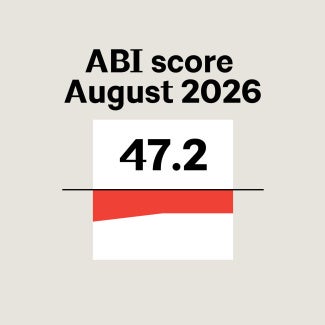
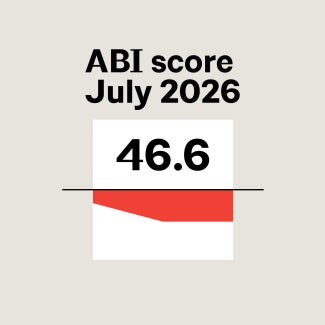
The AIA/Deltek Architecture Billings Index ® (ABI) score for the month was 47.3. While this score is nearly three points higher than the May score, it still indicates that a majority of firms reported a decline in billings this month, although fewer firms reported a decline than last month. Architecture firms remain mired in one of the longest-running downturns in the 30-plus year history of the ABI, which now stretches to 41 months without a majority of firms reporting billings growth. In a more positive sign, inquiries into new work at firms increased again in June, after a slight decline in May. And the value of newly signed design contracts was just slightly below 50, meaning that they are essentially flat, with an almost equal share of firms reporting a decline as reported an increase.
However, backlogs at firms also decreased slightly in the second quarter of the year, falling to an average of 6.3 months from 6.6 months in the first quarter. Backlogs decreased most precipitously at small firms with annual billings of less than $250,000, declining from an average of 4.9 months to just 3.1. Firms with a multifamily residential specialization also saw their backlogs decline from an average of 6.2 months to 5.3 months. While backlogs generally held steady at larger firms, smaller firms may be starting to work through their backlog of projects as they struggle to find new projects, which could leave them more vulnerable in the future if business remains slow.
Billings also declined at firms in all regions of the country in June, except for firms located in the South, where billings were essentially flat. Business conditions continued to soften further at firms located in the Midwest, after they experienced slight growth in the fourth quarter of 2025. Firms of all specializations also reported declining billings for the second month in a row. Firms with a multifamily residential specialization have seen the greatest drop off recently after experiencing more stable conditions earlier this year.
Economic signals improve, but risks remain
There were encouraging signs in the broader economy this month, but they may not end up being long-lasting. Inflation declined from May to June, as the Consumer Price Index (CPI) fell by 0.4% (although it remains up by 3.5% from one year ago). This decrease was led by a significant decline in energy prices, which fell by 5.7% in June, as the conflict in Iran temporarily stabilized. However, shelter and food costs continued to rise in June, and with challenges in the Strait of Hormuz returning, energy prices seem likely to rebound in July.
In addition, employment growth remained sluggish in June, with total nonfarm payroll employment adding just 57,000 new jobs. Growth has been soft for much of the year so far, with average monthly increases of just 36,000 positions over the last 12 months. Architectural services employment shed 300 jobs in May, the most recent data available, and is down 1,100 positions from this year’s peak in February.
Resilient design gains traction among firms and clients
For this month’s special practice questions, we asked architecture firms about recent projects with characteristics of resilient design. Overall, slightly fewer than half of responding firm leaders (44%) indicated that their firm has worked on any projects that have characteristics of resilient design over the past five years. This share was highest at firms located in the Northeast (53%) and South (50%), and lowest at firms located in the West, where just 33% reported working on resilient design projects in the past five years.
At firms that have worked on projects with characteristics of resilient design over the past five years, college/university education clients were the type most likely to have undertaken, or inquired about, these types of projects, as indicated by 29% of responding firm leaders. Next were multifamily residential clients (28%), health care clients (24%), government/civic clients (e.g., post office, federal office buildings) (23%), single-family residential clients (22%), office clients (22%), and K-12 education clients (20%). Firms reported little interest from commercial clients (e.g., retail, food services, warehouses) (4%), transportation clients (e.g., airports, rail, bus, mass transit) (6%), and hospitality clients (6%).
When asked about their best guess as to the share of their firm's projects (by dollar volume) that will have characteristics of resilient design in five years, responding firm leaders estimated that those projects will account for about 13% of their firm’s billings. One quarter of firms expect that they will account for 25% or more of their firm’s projects, and 24% expect that they will account for 10% to 24% of their projects. Firms located in the Northeast expect that resilient projects will account for approximately 16% of their firm’s work in five years, and small firms expect that they will account for an average of 18% of their firm’s projects.
- Join us for FREE at the next AIAU live webinar, Economic Update: Q3 2026 ABI Insights, on July 24, 2026, at 2pm ET.
-
 AIAThe AIA/Deltek Architecture Billings Index® (ABI) is a diffusion index derived from the monthly Work-on-the-Boards survey, conducted by the AIA Economics & Market Research Group. The ABI serves as a leading economic indicator that leads nonresidential construction activity by approximately 9-12 months. The survey panel asks participants whether their billings increased, decreased, or stayed the same in the month that just ended. According to the proportion of respondents choosing each option, a score is generated, which represents an index value for each month. An index score of 50 represents no change in firm billings from the previous month, a score above 50 indicates an increase in firm billings from the previous month, and a score below 50 indicates a decline in firm billings from the previous month.
 -
 AIAGraphs represent data from June 2025–June 2026.
 -
 AIAGraphs represent data from June 2025–June 2026 across the four regions. 50 represents the diffusion center. A score of 50 equals no change from the previous month. Above 50 shows increase; Below 50 shows decrease. 3-month moving average.
 -
 AIAGraphs represent data from June 2025–June 2026 across the three sectors. 50 represents the diffusion center. A score of 50 equals no change from the previous month. Above 50 shows increase; Below 50 shows decrease. 3-month moving average.
 -
 AIAPercentage of firms estimating the share of their firm's projects that will have characteristics of resilient design in five years.


This month, Work-on-the-Boards participants are saying:
- “Continues to be steady but bumpy. Would prefer to have a better backlog.”—7-person firm in the Northeast, institutional specialization
- “We have won work, but it won’t start. Too much “let’s wait and see” with geopolitical, interest rate, and economic questions.”—210-person firm in the South, commercial/industrial specialization
- “Seems to be more positive lately in regard to exploration of projects, feasibility, etc. Getting projects officially contracted and moving is still a little slow, showing apprehension from a building owner standpoint.”—74-person firm in the Midwest, institutional specialization
- “Things seemed to be moving toward positive ranges as the year started but have regressed significantly. This feels like a true recession on the construction front.”—5-person firm in the West, multifamily residential specialization
Join the ABI Work-on-the-Boards panel to participate in our monthly survey. Open to architecture firm owners, principals, and partners. All participants get a free ABI subscription.
The monthly AIA/Deltek Architecture Billings Index is a leading economic indicator for nonresidential construction activity.
Deltek is the home of AIA MasterSpec®, powered by Deltek Specpoint. Deltek helps A&E firms boost efficiencies while improving collaboration and accuracy.