July 2026 Consensus Construction Forecast
Nonresidential building construction reflects a K-shaped economy in 2026, marked by widening differences in performance across sectors.
Ongoing economic uncertainty has created a K-shaped nonresidential building outlook
A K-shaped economic situation refers to uneven conditions across different business sectors: some thrive, some hold steady, and others fall behind. That paradigm is currently evident in nonresidential building construction.
In 2025, spending put in place for nonresidential building construction fell 2% to $846 billion, as high interest rates, labor shortages, and rising material costs weighed on construction activity. Those pressures, combined with the start of the Iran conflict in February 2026, added another layer of economic uncertainty and contributed to a further pullback in nonresidential building spending.
Through the first five months of 2026, the sector has remained weak, with nonresidential building construction spending declining 7% in nominal dollars compared with the same period in 2025. As a result, members of the AIA Consensus Construction Forecast Panel downgraded their 2026 spending outlook from a 1.0% increase in this past January’s forecast to a 0.3% decline. The panel, however, has a somewhat more upbeat view for 2027, raising its spending forecast from a 2.2% increase to a 3.0% increase.
The institutional sector, composed largely of public building construction, saw very little change from the January 2026 forecast. After climbing 1.9% in 2025, institutional spending is now forecast to rise 2.8% in 2026 and 2.7% in 2027. The outlook remains strongest for healthcare construction as well as amusement and recreation construction.
The largest downgrade in the forecast was for manufacturing spending, which is now expected to decline 11.6% in 2026, following a 6.7% drop in 2025. The panel expects manufacturing spending to continue to fall in 2027, declining by an additional 0.6%. While the level of activity is expected to remain robust by historical standards, the declines represent a downshift following the massive infusion of public dollars from the CHIPS and Science Act and the Inflation Reduction Act. That pullback is being compounded by uncertainty over tariffs, which can make or break the decision to move forward with a multiyear capital project.
On the other side of the K-shaped outlook, the commercial forecast is more positive than it was in January. Commercial spending fell 3.2% in 2025, but the consensus now calls for a 4.8% increase in 2026, up from 3.0% in the January 2026 forecast, followed by 5.8% gain in 2027, up from 3.5% previously. That upgrade, however, is almost entirely due to the rapid growth of data center activity. If data centers were excluded from the commercial outlook, the predictions would be a 1% decrease in 2026 and a mere 1% increase in 2027.
That is the core of the K-shaped story: Parts of the market tied to public funding, health care demand, and AI-related investment continue to move forward, while more interest-rate-sensitive and discretionary sectors remain under pressure.
The macroeconomic outlook: The K-shape starts at the top
The weakness in construction reflects three major influences affecting the U.S. economy: cyclical pressure, structural shifts, and policy.
The cyclical pressure stems from high interest rates and persistent inflation, which have cooled consumer demand, tightened financing conditions, and led to an easing in the labor market. In that environment, developers are rethinking, delaying, or shelving projects.
Meanwhile, structural shifts are reshaping the outlook across most building sectors. A rapidly aging population drives demand for health care and related institutional services, while lower immigration and slower labor force growth are adding to workforce constraints. These dynamics affect not only the cost and availability of labor but also the long-term outlook for housing and school buildings.
The third influence is policy. Higher tariffs, increased immigration enforcement, and rising geopolitical risk have all added uncertainty to project planning.
In combination, these three forces have created a potent cocktail that will continue to weigh on material prices and building efforts.
More broadly, the U.S. economy remains steady, but it is far from strong. Gross domestic product growth is positive yet not especially robust. Consumer and business confidence remain weak, while the slowdown in the labor market and the affordability challenges facing many American households point to an economy operating close to stall speed. At the same time, the resilient stock market and massive spending on technology, AI, and data centers suggest an economy with meaningful upside potential.
In reality, the economy is treading water. Growth is expected to barely reach its roughly 2% potential rate, and the gap between the strongest and weakest parts of the economy continues to widen.
Additional stress comes from the conflict with Iran and the resulting run-up in global oil prices. Higher oil prices have already translated into higher gasoline prices and will eventually flow through to other products, compounding the affordability challenges already facing consumers and businesses.
For construction, the link between oil prices and material costs is especially important. Historically, a 10% year-over-year increase in the price of Brent crude has produced an additional 4% to 5% increase in construction material prices roughly three months later. Oil prices rose 54% in April, 66% in May, and 36% in June on a year-over-year basis, which could translate into a significant increase in construction material prices by the end of the summer.
Crude prices have moved lower as peace negotiations progressed, but the earlier gains will continue to reverberate through construction—and the broader economy—over the next several months. The concern over any resumption of hostilities and the potential for high oil prices to continue will be a cloud over the economy for some time.
Higher oil prices, along with broader cost pressures, also create a challenge for the Federal Reserve. Core inflation, which excludes volatile food and energy prices, remains well above the Fed’s 2% target. As a result, the Fed is unlikely to cut interest rates in the near term. Indeed, if inflation continues to trend higher, the risk remains that the Fed could be forced to raise rates again to keep inflation in check.
With interest rates likely to remain higher for longer, the construction sector will struggle to gain traction outside of a limited number of growth areas, including data centers, health care, and select publicly funded institutional projects. The result is not a uniformly weak construction market but an unusually uneven, K-shaped one.
Architecture billings signal more weakness ahead
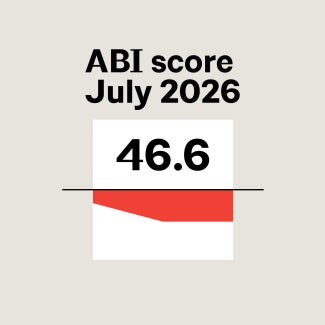
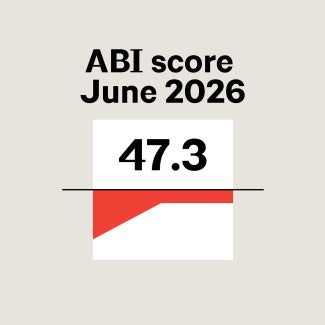
This leaves the outlook for construction spending increasingly unclear. The AIA/Deltek Architecture Billings Index® (ABI), which typically leads nonresidential construction spending by roughly 9 to 12 months, has shown that billings at architecture firms have been steadily declining since early 2023. Those declines have persisted into this year, reinforcing the view that weakness in project activity is likely to continue in the near term.
But the K-shaped pattern evident in the broader economy and across construction sectors is also visible in the underlying billings data. Billings have been relatively stable in the South and, to a lesser extent, in the West. By contrast, firms in the Northeast and Midwest have seen more persistent pullbacks
One positive signal from the ABI has been the relative strength in project inquiries, which have generally improved over the past two years. That suggests developers and owners are still exploring potential projects and remain interested in moving work forward. The challenge is that interest is not consistently turning into billable work. Once owners and developers get a clearer picture of construction costs, budgets, financing conditions, and broader economic risks, many appear to be delaying or shelving projects rather than proceeding.
Taken together, the ABI supports the panel’s forecast that spending across most nonresidential building categories will remain under pressure throughout the remainder of the year. It also reinforces the larger point: This is not a market defined by universal weakness but by uneven momentum. A handful of sectors and regions continue to show resilience, while much of the market remains stuck in the doldrums.
The top, bottom, and middle of the K-shaped outlook
The top arm of the K-shaped outlook contains construction categories that are growing.
Data centers: Data centers stand alone at the top of the construction spending outlook. They have been on a stratospheric rise over the last several years, and the forecast calls for continued growth in 2026 (+33%) and in 2027 (+25%). By 2027, data centers will account for roughly 8% of all nonresidential building spending.
Hotels: While a small category, the outlook for hotel spending is the most positive amongst the traditional commercial sectors. The panel anticipates that spending will post solid gains in both forecast years: +4.6% in 2026 and +5.2% in 2027. Spending on hotel construction has struggled to gain traction since the pandemic. Given the intense competition for travel dollars, hotel chains may be starting to bet that facility upgrades and new buildout will lead to increased revenue.
Health care: Spending on health care construction will plod ahead in 2026, with a 2.6% increase, and the panel expects spending to accelerate to 4.4% in 2027. The aging U.S. population has lifted the demand for health care buildings, from hospitals to outpatient clinics and nursing homes. (Note: Independent living facilities are mostly captured in multifamily construction spending.)
Amusement and recreation: This category is a catch-all that encompasses projects like theme parks, sports facilities (arenas), gyms, and performance and movie theaters. Spending grew 6% in 2025 due to strong activity in the sports facility and performance/meeting center subcategories. Spending is forecast to rise 7.1% in 2026 and 3.0% in 2027. Projects such as the Continental Coliseum in Oklahoma City (costing $990 million) and the new stadium for the Washington Commanders will impact this category for years to come.
Meanwhile, the bottom arm of the K-shaped economy contains categories that are retreating.
Traditional offices: Office construction was severely hobbled by the pandemic as white-collar jobs shifted to remote work. This left a large swath of vacant space throughout the country. As vacancies rose, office construction fell, and by 2025, the sector lost 22% off its pre-pandemic peak. The slack in the labor market has allowed some companies to begin pulling their workers back into an office setting, either hybrid or full-time, which will start to reduce vacancies over the longer term. Panelists, however, feel that spending will decline again in 2026, by 5.1%, with a further 4.5% decline on tap for 2027.
Warehouses: While the pandemic pushed office construction lower, it was a boon for warehouse construction as e-commerce giants like Amazon began to build out their logistics infrastructure. Construction spending peaked in 2023 at $80 billion, but Amazon began to pare back and ultimately stop new warehouse buildouts. Since then, spending has been on a steady decline, hitting $55 billion in 2025, which is 31% below its peak. The updated forecast anticipates one more year of decline, with spending dropping by 1.7% before increasing by 1.4% in 2027.
Manufacturing: Manufacturing construction spending peaked in 2024 as public dollars flooded the market and semiconductor and electric-vehicle-related manufacturing plants broke ground. While construction has ebbed since then, the level remains very high by historical standards. The forecast predicts a further decline in 2026 before essentially flat conditions arrive in 2027.
The remaining sectors in the K-shaped outlook are treading water.
Retail: Retail and other commercial construction will inch forward in 2026, growing by 0.7% from 2025 levels. Much of the sector's strength has been in the “multi-retail” subcategory, which aligns with growth in the multifamily market. The forecast calls for accelerated growth in 2027, with spending rising 2.7%.
Education: The education sector is one of the largest in the nonresidential building space, and it is generally one of the more stable. The forecast calls for tepid growth in both 2026 (+1.2%) and 2027 (+0.9%). Building momentum will be a challenge as U.S. population growth slows to a crawl. However, this pain will likely not be shared equally across the country. Demographic growth in the Sunbelt and affordable states in the South and West will likely see the bulk of any new buildout, while states with slower growth will likely see a focus on renovation and rehab work.

Build an AI-ready architecture firm with a practical, step-by-step interactive resource for adopting AI responsibly.