ABI October 2026: Architecture firm billings continue to decline
An average of 10% of architecture firm billings are from activities that don’t directly result in design or construction activity.
Architecture firm billings continued to decline in October.
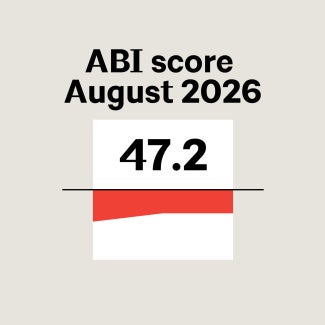
The AIA/Deltek Architecture Billings Index® (ABI) score remained well below 50 at 44.9 for the month, as billings have not been in consistently positive territory for more than four years now. While this does not mean that business is soft at every firm, it means that billings continue to decline from one month to the next at a majority of firms. Inquiries into new projects increased again in October, as clients remain interested in starting projects, but the pace of that increase slowed from September. And despite inquiries from potential clients, the value of newly signed design contracts remains weak as it continues to decline like billings.
Business conditions were also soft at firms in all regions of the country in October. For the fourth consecutive month, they were weakest at firms located in the Northeast, although they have also softened further at firms located in the Midwest and South in recent months. However, billings were essentially flat at firms located in the West for the third consecutive month, which is encouraging. By firm specialization, billings increased for the second consecutive month at firms with a commercial/industrial specialization. This marks the first period of growth at these firms since 2022. However, after showing some signs of improvement at the beginning of the year, billings have softened significantly at firms with institutional and multifamily residential specializations this fall.
Broader economy shows job gains as inflation eases
Despite soft conditions in the architecture industry, conditions in the broader economy were more encouraging in October. Total nonfarm payroll employment grew by 165,000 new positions, well above the recent monthly average of 48,000, while the unemployment rate remained low at 4.1%. Architectural services employment added 100 new jobs in September (the most recent data available), for a total of 204,000 employed in the industry. This is 900 positions higher than the June low.
Inflation also softened modestly in October, with the Consumer Price Index (CPI) rising by 0.4%, after increasing by 0.6% in September. The largest contributor to the slower growth rate was stabilization in energy prices: energy prices overall increased by 0.7% (after increasing by 5.2% in September, while gasoline prices rose by 1.0%, down from 9.1% in September. However, food prices increased by 0.5% in October after they were flat in September.
Most firms report billings from activities that aren’t intended to result in design or construction activity directly
In this month’s special practice questions, we asked architecture firm leaders about recent billings at their firms derived from activities that weren’t intended to result in design or construction activity directly. Overall, responding firm leaders reported that an average of about 9.7% of their firm billings over the last year were from activities that weren’t intended to result in design or construction activity directly. While 14% of responding firm leaders reported that they had no billings from this type of work, 11% reported that 20% or more of their billings came from this work, with 2% reporting that it accounted for 50% or more of their billings. Small firms with annual billings of less than $250,000, firms located in the Northeast, and firms with an institutional specialization reported the highest shares of billings from this type of work, at an average of 14.3%, 11.2%, and 10.3%, respectively.
When asked how the share of billings derived from activities that weren’t intended to result in design or construction activity has changed in recent years, nearly one quarter of responding firm leaders (23%) reported that it had increased, while 66% said that it had remained about the same, and 11% said that it had decreased. Firms located in the Northeast were least likely to report that this share had increased (13%) and were most likely to report that the share had decreased (18%).
When asked specifically which services are not among standard design services their firm provides, by far the most frequently selected type, by 83% of respondents, was planning and pre-design services. This was followed by non-design/construction consulting services (24%), owner representative services (20%), research studies and application (19%), environmental consulting services (8%), and building operation and maintenance services (5%). In addition, 9% indicated that their firm doesn’t provide non-standard design services. When asked to select which type of non-traditional design services is the primary one offered by their firm, nearly three-quarters (74%) selected planning and pre-design services, with just 5% each selecting owner representative services and non-design/construction consulting services. However, 12% of small firms with annual billings of less than $250,000 selected owner representative services, and 11% of firms with a multifamily residential specialization selected non-design/construction consulting services.
-
 AIAThe AIA/Deltek Architecture Billings Index® (ABI) is a diffusion index derived from the monthly Work-on-the-Boards survey, conducted by the AIA Economics & Market Research Group. The ABI serves as a leading economic indicator that leads nonresidential construction activity by approximately 9-12 months. The survey panel asks participants whether their billings increased, decreased, or stayed the same in the month that just ended. According to the proportion of respondents choosing each option, a score is generated, which represents an index value for each month. An index score of 50 represents no change in firm billings from the previous month, a score above 50 indicates an increase in firm billings from the previous month, and a score below 50 indicates a decline in firm billings from the previous month.
-
 AIAGraphs represent data from October 2025–October 2026.
-
 AIAGraphs represent data from October 2025–October 2026 across the four regions. 50 represents the diffusion center. A score of 50 equals no change from the previous month. Above 50 shows an increase; Below 50 shows a decrease. 3-month moving average.
-
 AIAGraphs represent data from October 2025–October 2026 across the three sectors. 50 represents the diffusion center. A score of 50 equals no change from the previous month. Above 50 shows an increase; Below 50 shows a decrease. 3-month moving average.
-
 AIAPercentage of firms, current estimate for net revenue change for 2026 as compared to 2025, and projected change for 2027 compared to 2026


This month, Work-on-the-Boards participants are saying:
- “Our target markets within higher education are experiencing drastic cuts in science and technology funding, and belt tightening around facilities due to uncertainty and demographic shifts. These two forces are reducing opportunities and creating uncertainty around project financing.”—120-person firm in the South, institutional specialization
- “We have won a reasonable number of projects recently, but they are relatively small in scale. The larger ones seem to be taking longer to get approved.”—11-person firm in the Midwest, commercial/industrial specialization
- “Steady for now, although there is a long-range dropoff in our public institution markets. Looking to other project types to expand expertise.”—21-person firm in the West, institutional specialization
- “A lot of projects are not penciling out financially”—14-person firm in the Northeast, multifamily residential specialization
Join the ABI Work-on-the-Boards panel to participate in our monthly survey. Open to architecture firm owners, principals, and partners. All participants get a free ABI subscription.
The monthly AIA/Deltek Architecture Billings Index is a leading economic indicator for nonresidential construction activity.
Deltek is the home of AIA MasterSpec®, powered by Deltek Specpoint. Deltek helps A&E firms boost efficiencies while improving collaboration and accuracy.

Firm revenue is down by an average of 3% from 2025, expected to remain flat in 2027.
Nearly half of architecture firms are actively engaging with AI.