
Design for Water—Framework for Design Excellence
Good design conserves and improves the quality of water as a precious resource.
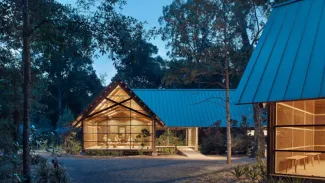
Design for Water
Framing questions
- How does the project use water wisely, addressing efficiency and consumption while matching water quality to appropriate use?
- How can the project’s water systems maintain function during emergencies or disruptions?
- How does the project handle rainfall and stormwater responsibly?
- How does the project contribute to a healthy regional watershed?
If you can do only one (or a few) things:
- Zero carbon: Incorporate water reuse and reduction strategies and understand the relationship between energy, water, and carbon.
- Resilient: Project future climate conditions and establish strategies to manage water at the building and site, including effects on the watershed.
- Equitable: Identify stakeholders impacted by water use decisions and take steps to correct historic inequities.
- Healthy: Protect water sources for the site, downstream communities, and future consumers. Understand the water quality delivered to the site and emitted from the site.
Focus topics
Vulnerable communities are often the hardest hit by water-related crises. As of 2017, over 1.1 million individuals in the United States lacked access to complete plumbing facilities, of which 73% were households located in cities. Where water service is available, it doesn’t mean it is affordable. The lowest 20% of earners spend almost one-fifth of their monthly household income on water. In virtually every community, there are some vulnerable populations—including elderly, disabled, and low-income residents—who struggle to pay their water bills.
Water shapes economic growth, the environment, and the social fabric of our communities. By engaging water stakeholders in a project's decision-making, project teams can help all communities preserve access to safe, clean, affordable drinking water and share in the economic, social, and environmental benefits of high-quality, equitable, and resilient water systems.
Water resilience refers to the ability of an individual, community, or other scaled system to respond and adapt to crises—and to treat them as opportunities for transformation and improvement. It encompasses the capacity of all people—including vulnerable communities—to respond to shock and trauma of all kinds. In the context of water, resilience is the ability to withstand the vulnerability caused by climate impacts and natural disasters. Water equity refers to just and fair inclusion—a condition in which everyone has an opportunity to participate and prosper.
Water equity occurs when all communities have access to safe, clean, affordable drinking water and wastewater services; are resilient in the face of floods, drought, and other climate risks; have a role in decision-making processes related to water management in their communities; and share in the economic, social, and environmental benefits of water systems.
Each day, more and more Americans are confronting an unsettling fact of life in the 21st century: Our supplies of clean, dependable, economical water are more fragile than at any time in our recent history.
Equitable access to water systems:
- Provide access to safe, potable water supplies and wastewater services.
- Consider the long-term benefits of green infrastructure in economic analyses of stormwater management plans. Engage local appraisers and commissioners to educate them on the full value of green infrastructure. Incorporate co-benefits into ROI calculations, such as ecosystem services and quality-of-life factors.
- Support and grow local water districts. Nurturing water districts in the water sector—networks of companies, universities, NGOs, and other organizations that leverage a region’s assets to create economic opportunity and catalyze innovation—are important vehicles for accelerating adoption of new technologies.
- Rather than starting a conversation with a discussion about minimum code requirements, map out who the watershed stakeholders are and engage with key stakeholders in decision-making opportunities.
- Seek stakeholder agreement on goals that are informed by historical data, current water access conditions, and future climate projections, and reflect the risk tolerance of the community.
- Develop a community "wish-list" of water systems goals that can be utilized by other projects to improve neighborhood access to quality, equitable, and resilient water systems.
Water system resilience:
- Stagnant or standing water in a plumbing system can increase the risk for the growth and spread of Legionella and other associated bacteria. When water is stagnant for long periods of time, hot water temperatures can decrease to the Legionella growth range (77–108° F). Consider developing a Legionella management plan.
- Inform owners and maintenance staff about the risks associated with prolonged building closure.
- Consider developing a comprehensive water management program for your water system and all fixtures/devices that use water.
- Flush your water system regularly and develop protocols for building maintenance.
- If the project requires continuity of operations, plan for sufficient potable water storage to serve occupants during the anticipated period of service interruption.
- If municipal sewer supplies are not covered by backup generators, projects that continue operations in a disaster may require adequate storage chambers for wastewater as well.
Scale & equity:
- Understand how the project site fits into its regional water system. Identify the watershed, groundwater, and historic and current functioning of the regional water system.
- Determine water hazards known to happen within the watershed (e.g., flood events, large snowfalls, severe storms, and durations of extreme droughts). Consider how climate change will affect the site over the service life of the project, and plan how the site/building will adapt to these changes.
- Design site for post-development water discharge volumes, rates, and quality to improve or maintain regional water systems.
- Conserve and protect water-based ecosystems, including wetlands and water-based habitats that provide critical ecosystem functions for fish, other wildlife, and people.
- Develop a watershed stakeholder map and understand who will be impacted by your project’s decisions.
- Collect information about any available wastewater treatment infrastructure serving the site. Determine how the water will be distributed and treated, and where it will be discharged. If municipal treatment facilities are available, investigate the average water treatment cost, location, capacity, type, and level of treatment for the wastewater system and treatment facilities. Evaluate the suitability of the site for on-site treatment options, following local codes and regulations. Understand the treatment quality required and design treatment systems to achieve those goals.
- Identify potential contamination risks from nearby industrial, agricultural, transportation, and residential sources that may overload local water management infrastructure.
- Design the project to minimize contamination entering groundwater and flowing off the project site. Educate building owners on the importance of minimizing the use of potential contaminants (chlorides, phosphates, etc.). Determine the location, capacity, type, and cost of potable (and/or non-potable) water systems serving the site. Most commonly, this will be a municipal supply or a local well.
- Consider the communities that will be receiving the water supply. Consider the site-specific and neighborhood requirements for locating distribution lines.
- Determine the makeup and quality of the potable water available to the project through sampling and testing. Test for turbidity, contaminates, and additives.
Resources
Clean water is essential to life, prosperity, and progress. The unfortunate reality is that water challenges disproportionately affect the most vulnerable people in America. Strategies for water equity include providing access to safe, reliable, and affordable potable water and wastewater systems—recognizing and mitigating impacts on the surrounding community, historical water flows, and ecosystems.
Safe, potable water must be collected, treated, and transported to users efficiently. The delivery system consists of a complex distribution network that must be monitored and maintained continuously. Traditionally, urban water systems have been managed by the municipality, while rural areas tend to utilize on-site solutions.
The first step to reducing potable water use is to determine where it is really needed. Is potable water necessary to irrigate a lawn or to use in the cooling tower?
Actions:
- Develop a water budget analysis (also referred to as a water flow analysis) to determine the water resources available to the project, how much water is needed, and how the water system can minimize the use of potable water. The water budget analysis should consider the outdoor and indoor water resources as a unified system.
- Calculate the quantity of water used compared to the code baseline. The calculation is based on building occupancy—full-time employees plus visitors or guests—on an annual basis. The COTE Super Spreadsheet has a calculator that will establish a baseline and show a percent reduction of water use.
- Use low-flow toilets, sinks, and fixtures. Many projects can achieve 30% reductions over code through smart flush and flow choices; however, we increasingly see solutions that target 50% or greater reductions. Use only WaterSense-labelled fixtures.
- Install permanent meters to measure potable water use and track data on a monthly basis.
- Install a leak detector/monitoring system to alert building owners to microleaks or larger issues.
- Based on user behavior research, dual-flush toilets are recommended only in private situations (such as a private residence). In public locations, low-flow fixtures are best.
- Consider providing uninterruptible sources of potable water for use in emergencies or other disruptions.
- To go even further, specify waterless urinals or composting toilets. Understand, however, that waterless technologies require additional maintenance and user training.
Resources
Reduce or eliminate the need for potable water usage in landscaping. The water collected on-site can be used to support a healthy watershed if rainwater is slowed, cooled, and cleansed as much as possible with rain gardens, bioswales, proper tree root zones, and other permeable and nature-based solutions that utilize soil structure and the evaporative characteristics of vegetation to cycle water locally and safely divert surplus from extreme storm events.
Actions:
- Consider vegetated roofs to the maximum extent possible. Consider using vegetated roofs where they will be visible and accessible from interior programmed spaces.
- Capture and collect rainwater to the highest degree possible. Consider using rainwater to offset irrigation demand and for flush toilet fixtures. Rainwater can also be treated and used for the project’s drinking water or chiller plant demand.
- Keep impervious surfaces to a minimum. Consider stacking the architectural program, minimizing parking lot sizes, and maximizing efficiency in vehicular circulation.
- The amount of water that runs off the site should match the site’s predevelopment conditions or improve conditions for the surrounding sites.
- Consider the site's hydrology and geology to determine the best use for the site’s rainwater (e.g., reuse, infiltration, or another solution).
Resources
Rainwater should be managed close to where it falls. Projects that manage their rainwater on-site put less pressure on the municipal storm sewer systems and receiving streams, help recharge the groundwater supply, and generally keep our water resources cleaner. Resilient strategies use water that falls on a project site to its fullest potential, with opportunities for collection and reuse to maintain continuity of operations and save potable water for essential functions.
Actions:
- Consider vegetated roofs to the maximum extent possible. Consider using vegetated roofs where they will be visible and accessible from interior programmed spaces.
- Capture and collect rainwater to the highest degree possible. Consider using rainwater to offset irrigation demand and for flush toilet fixtures. Rainwater can also be treated and used for the project’s drinking water or chiller plant demand.
- Keep impervious surfaces to a minimum. Consider stacking the architectural program, minimizing parking lot sizes, and maximizing efficiency in vehicular circulation.
- The amount of water that runs off the site should match the site’s predevelopment conditions or improve conditions for the surrounding sites.
- Consider the site's hydrology and geology to determine the best use for the site’s rainwater (e.g., reuse, infiltration, or another solution).
Resources
Depending on the type of building, processed water might be available for industrial or manufacturing purposes (or from washing dishes or clothes).
Actions:
- Select water-efficient dishwashers, washing machines, and water fountains. (Check out Energy Star products.)
- Condensate from HVAC systems can be captured and used for another purpose, such as irrigation or flushing toilets.
- If using evaporative cooling equipment or cooling towers:
- Use non-potable water, if possible.
- If using potable water, avoid single-pass cooling.
- Conduct a one-time potable water analysis, measuring at least calcium (Ca), total alkalinity, silicon dioxide (SiO2), chlorine (Cl), and conductivity.
- Maximize cooling tower cycles and avoid exceeding the recommended maximum values for any of these parameters.
Install makeup water meter(s). - Install conductivity controllers and overflow alarms.
- Install efficient drift eliminators.
- If utilizing boiler and steam systems:
- Install and maintain a condensate recovery system to capture and return condensate to the system for reuse.
- Install flow meters on makeup and blowdown lines.
- Install a conductivity controller to automatically control blowdown.
- Automate chemical feed systems.
- Talk to your water treatment vendor about pretreatment or side-stream filtration.
Resources
Greywater is lightly soiled water that can be reused for non-potable uses with minimal or no treatment. The best practice is to use all water for multiple purposes before releasing it. Blackwater is heavily soiled water from a toilet or commercial kitchen disposal that is dangerous to humans and cannot be used until treated.
Actions:
- Explore systems for purifying rainwater or treating and reusing greywater and blackwater, compostable toilets, and alternate systems.
- In addition to the typical greywater sources—such as lavatory sinks, dishwashers, clothes washing, showers, condensate traps, and process wastewater—be sure to explore all possible water sources, including foundation groundwater, washdown water, etc.
- Consider using greywater for site irrigation and/or plumbing fixture flushing.
- Consider on-site strategies for treating blackwater, including engineered wetlands.
Resources
Water use in the United States requires vast amounts of energy, resulting in considerable greenhouse gas emissions that contribute to global warming. Energy is required whenever water is moved uphill, treated, heated, cooled, or pressurized. The carbon emissions associated with U.S. water use are approximately 290 million metric tons a year. The energy required for supplying and treating water and wastewater constitutes the largest energy cost for many local municipalities.
According to the Federal Energy Management Program website, “Net zero water creates a water-neutral building where the amount of water used and returned to the original water source is equal to the building's total water consumption.” The goal of net zero water is to preserve the quantity and quality of natural water resources with minimal deterioration, depletion, and rerouting by utilizing potential alternative water sources and water efficiency measures to minimize the use of supplied fresh water.
Ultimately, according to the Federal Energy Management Program under the Department of Energy, a net zero water building (or campus) completely offsets water use.
Actions:
- Translate carbon impacts of regional water infrastructure in carbon per gallon of water supplied to the site.
- Connect water conservation targets with carbon reduction strategies.
- Calculate carbon sequestration potential from low-impact development (LID) practices—such as bioswales, green roofs, rainwater harvesting, rain gardens, and green streets.
- Reduce demand by employing innovative technologies that consume less water.
- Produce alternative water sources to offset purchased freshwater.
- Treat wastewater on-site and reuse or inject treated wastewater into the original water supply.
- Implement green infrastructure by diverting stormwater to allow infiltration before returning the remainder to its original outfall.
Resources
Case studies
Explore AIA award recipients, including the COTE® Top Ten Award, demonstrating successful design for this framework principle.
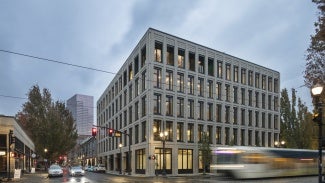
Portland, OR | ZGF Architects
PAE Living Building is fully disconnected from city water and sewer. Rainwater collection is utilized for all building needs, while blackwater is recycled into liquid fertilizer and compost.
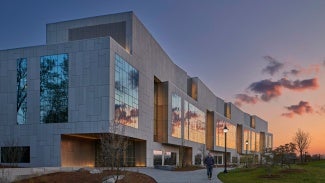
University of Connecticut—Science 1 Research Center
Storrs, CT | Payette
The STEM Research Center employs low-impact-development strategies to capture and treat stormwater, mitigating runoff concerns. It also connects to the university’s reclaimed water system, reducing indoor non-potable water use.
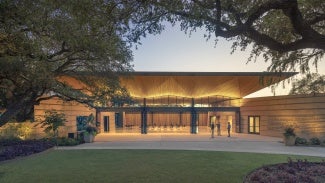
San Antonio, TX | Weddle Gilmore Architects
The botanical garden implements a cohesive stormwater management plan, capturing rainwater and HVAC condensate for reuse. Vegetated bioswales are highly visible, allowing visitors to understand how collected water is managed.
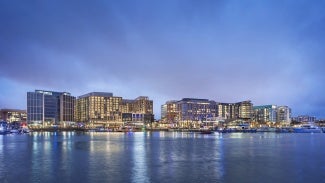
Washington, D.C. | Perkins Eastman
The Wharf demonstrates site connectivity through water. Designed to exceed the storage from above-average storms, water is collected and diverted from the nearby river channel for beneficial reuse of irrigation, toilet flushing, and colling tower make-up.
This publication is designed to provide accurate and authoritative information in regard to the subject matter covered. It is published and distributed with the understanding that the publisher is not engaged in rendering professional services. If professional advice or other expert assistance is required, the services of a competent professional person should be sought.
AIA does not sponsor or endorse any enterprise, whether public or private, operated for profit. Further, no AIA officer, director, committee member, or employee, or any of its component organizations in his or her official capacity, is permitted to approve, sponsor, endorse, or do anything that may be deemed or construed to be an approval, sponsorship, or endorsement of any material of construction or any method or manner of handling, using, distributing, or dealing in any material or product.
If you have any questions or feedback regarding the Framework for Design Excellence, please let us know.
Learn how the framework inspires and provides a toolkit for sustainable, resilient, and inclusive design.
Explore the next chapter of the Framework for Design Excellence—Design for Economy