

Why materials matter
Specify the right window and door frame material to set a quality standard for the entire project. AIA partner Marvin explains how.
Among the dozens of window and door decisions an architect needs to make, perhaps none is more important than the selection of the frame material. In addition to impacting dimensions, operation type, finish, hardware, and glazing, selecting the right frame material plays a crucial role when working with multiple large openings where mulling pieces are more exposed to the elements.
When you’re the lead decision-maker in assembling construction documents, details, and specifications, knowing the characteristics of window and door frame materials can help achieve the perfect fit for your design.
Wood and clad wood
Wood is the most common window and door frame material. Strength, dimensional stability, and resistance to warping and twisting are critical. Properly protected wood windows have lasted hundreds of years.
In the United States, pine, mahogany, Douglas fir, and white oak seem to be the most prevalent species for window and door frames. Many manufacturers offer different wood species for the frame interiors, including pine, cherry, oak, and vertical grain Douglas fir. The warmth of natural wood interiors is a major design feature.
Carefully review specifications and product performance to ensure the structural capabilities of a wood window or door. There are occasions where vertical or horizontal mullions may require additional reinforcement, depending on the span and frame material.
Windows and doors with aluminum cladding gained popularity in the 1960s and have evolved since that time. The original approach was to cover wood with thin roll-formed aluminum. A more effective approach now involves an outer layer of extruded aluminum, which is far superior in both appearance and performance. Extruded aluminum can provide multiple section profiles to enhance both traditional and modern designs, with refined edges that provide crisp shadow lines and tight joints.
The ability to customize the extruded aluminum profile for a specific project provides architects with design flexibility, including the ability to create historic profiles that integrate with older buildings. Contemporary coating technologies offer an endless range of color choices and exceptional durability. Best of all, the extruded aluminum shell is structurally bonded to the wood frame, creating a composite assembly that results in greater strength, enhanced moisture resistance, and improved thermal performance.
Acetylated wood (Accoya)
Acetylated wood, sold under the trade name Accoya, typically uses fast‑growing, second‑growth species such as radiata pine. The wood is modified at a cellular level to greatly reduce water absorption and rot, with some products carrying warranties of up to 50 years. For window and door frames, acetylated wood provides all the benefits of traditional wood with added durability and moisture resistance. While the initial cost is higher than standard wood, its extended lifespan can make its overall lifecycle cost more affordable.
-
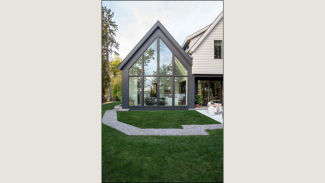 MarvinExterior shot of windows from Marvin.
 -
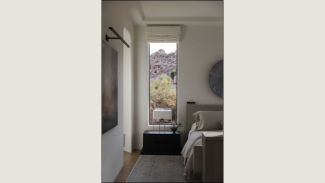 MarvinInterior shot of a window from Marvin.

Thermoplastic composites
Thermoplastic composites are economical to produce, have a relatively low initial cost, and are easier to recycle. They can contain vinyl and wood fibers that are heated or melted and poured into forms. While featuring a high strength-to-weight ratio and water resistance, thermoplastic composites also have low resistance to impact and can have a higher expansion/contraction rate.
Vinyl
Affordability is the main advantage of vinyl as a frame material, primarily for windows. It is often used as a cladding material or for a portion of a composite frame assembly over a wood sub-structure. When it is the only material in a window frame, it is less rigid and more prone to thermal movement than many of the alternatives. Lower-quality vinyl windows may off-gas, causing them to turn yellow and become brittle after exposure to the sun and heat. Joints are often heat-welded or glued together and can also be prone to degradation over time.
Vinyl is a good insulator and resists moisture damage. It needs little maintenance and can be formed into a wide variety of profiles to complement your design. It is, however, typically limited in color selections, and, due to its low flexural strength, it may be inappropriate for larger openings. Vinyl frames can be reinforced with steel inserts to increase strength, but these inserts may reduce thermal performance. Because of its affordability and ease of manufacturing, vinyl is typically a good choice for replacement windows when the budget is a major concern.
Learn more today about window and door materials. Download the white paper: Frameworks for Success.
AIA does not sponsor or endorse any enterprise, whether public or private, operated for profit. Further, no AIA officer, director, committee member, or employee, or any of its component organizations in his or her official capacity, is permitted to approve, sponsor, endorse, or do anything that may be deemed or construed to be an approval, sponsorship, or endorsement of any material of construction or any method or manner of handling, using, distributing, or dealing in any material or product.