
Mentorship at AIA
Mentorship is a powerful driver of career success—supporting professional growth, well-being, and retention and recruitment—while helping build a more diverse and inclusive workforce.
AIA connects its members with strong mentorship programs that benefit individuals, organizations, and the profession as a whole—advancing careers for both mentors and mentees.
How AIA supports mentorship
AIA recognizes that mentorship takes many forms across its 101,000+ members, with firms, chapters, committees, and external organizations contributing to supportive professional networks. Rather than standardizing mentorship across all facets of the profession, AIA focuses on strengthening and connecting these existing efforts while encouraging the growth of new networks and programs. By developing shared resources, facilitating collaboration among chapters, and elevating both emerging and established initiatives, AIA promotes intentional, inclusive mentoring practices that amplify impact across the profession.
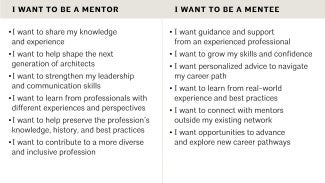
Choose your mentorship path
Most professionals will be both mentors and mentees at different points in their careers—where would you like to start?
- AIA Mentorship Framework
This framework is designed to help AIA chapters, firms, committees, and affiliated groups plan, implement, and evaluate inclusive mentorship programs. - AIA Guides for Equitable Practice: Intercultural Competence
This second edition guide provides strategies for mentors and professionals to build intercultural awareness, foster inclusion, and engage respectfully across diverse perspectives. - AIA Guides for Equitable Practice: Mentorship and Sponsorship
This second edition guide focuses on effective mentoring and sponsorship practices, emphasizing equitable access, professional development, and relationship-building strategies. - How to Create and Facilitate a Mentorship Program
This toolkit was created by the Young Architects Forum is designed to help AIA members build successful and scalable mentorship programs.
AIAU Inclusive Mentorship Series
This three-course series is designed to help participants build mentoring relationships that are thoughtful, inclusive, and impactful.
Participants who successfully complete all three courses earn a digital badge recognizing their achievement and commitment to inclusive mentorship.
Course 1 (required prerequisite)
Completion of either course 1 option is required before enrolling in courses 2 and 3.
Becoming An Inclusive Mentor (1.5 LUs)
Learn how to build strong mentoring relationships, set clear expectations, recognize bias, foster equitable growth, and navigate common mentoring challenges with confidence and empathy.Becoming An Empowered Mentee (1.5 LUs)
Learn how to build strong mentoring relationships, set clear goals, communicate with confidence, expand your professional network, and take an active role in your professional development through inclusive, equitable practices.Course 2
Mentorship in Action* (3 LUs)
Build on the foundation established in Course 1 through a structured mentoring relationship, guided conversations, goal setting, and reflection.Course 3
Mentoring Beyond Practice* (3 LUs)
A capstone experience in which participants analyze outcomes, reflect on inclusion, bias, and power dynamics, and identify how their mentoring experience will inform future professional practice.
*After verified completion of the prerequisite course(s), participants will receive an email invitation with registration instructions for the next course.
- AIA College of Fellows
The AIA College of Fellows honors architects who have made exceptional contributions to the profession and society—an elite distinction held by less than 3% of AIA members. Since its founding in 1952, the college has championed knowledge-sharing, leadership, and service through the AIA College of Fellows Component Grant as well as its support and affiliation with mentorship programs such as ALIGN and Nexus. - AIA Young Architects Forum (YAF)
The Young Architects Forum represents the interests of architect members licensed for 10 years or less. YAF programs, activities, and resources serve young architects by providing information and leadership; promoting excellence through fellowship with other professionals; and encouraging mentoring to enhance individual, community, and professional development. The Young Architects Forum and College of Fellows Align Mentoring Program is a long-range initiative that connects young architects with AIA Fellows through a grouping system referred to as “pods”. The program began in 2019 and has an annual Call for Applications. - AIA Knowledge Communities
Interest-based networks within AIA where architects connect, share resources, and deepen expertise in areas like sustainability, health care, urban design, and technology. These communities organize events, publish thought leadership, and foster peer collaboration across the profession. - Find my chapter
With over 200 chapters in the U.S. and abroad, many chapters host or are connected with local mentorship programs. - NCARB Licensing Advisors
A network of volunteer professionals, educators, and students who provide guidance to architectural licensure candidates on navigating NCARB’s AXP, ARE, and certification requirements. - ACE Mentor
A free, after-school mentoring program that connects high school students with architects, engineers, and construction professionals. Mentors guide teams through real-world design challenges while promoting diversity, early career exposure, and scholarship opportunities. - The American Institute of Architecture Students (AIAS)
AIAS is a student-run organization focused on leadership, design, and service for architecture students. AIAS fosters community, professional development, and advocates for equity and innovation in architectural education. - NOMA Project Pipeline
A NOMA-led program that empowers youth—especially students of color—to explore architecture by using the city as a classroom. Through summer camps and design-build experiences, students create meaningful projects, engage with architects and planners, and build skills in civic design.