Design for Aging Award
Recognizes architects who demonstrate innovative design solutions to improve the quality of life for older adults.
The Design for Aging Award is now accepting submissions for the 2027 cycle. Apply by Tuesday, November 3, 2026, to be considered.
Questions? Please visit the AIA Awards FAQ for more information on the awards submission process.
Recognizing innovative design for older adult living
The Design for Aging Award furnishes architects and their teams the opportunity to demonstrate innovative solutions that improve the quality of life for older adults within specific project constraints. This award offers examples of a broad range of design strategies and depicts conscientious surroundings that advance environments for senior living. Recipient projects will become a reference for providers, developers, users, advocates, architects, interior designers, landscape architects, and other design professionals.
Questions? Email AIA Awards
Entrants
- All entries must identify an AIA Architect member in good standing (e.g., current on dues, no ethical violations) that is licensed to practice in the U.S., affiliated with the project to serve as the project Submitting Architect
- Submitting architects do not have to be the head of the team
- Projects must credit every substantial contributor.
- Owners, individual practitioners, private design firms, public agencies, civic organizations, and public interest groups can submit projects or programs in which they were involved.
- Projects may only be submitted once, under one Design for Aging category. If a project can be classified under more than one category, applicants are encouraged to choose the one they think best applies to their project.
Projects
- New construction, renovations, and restorations are eligible.
- Projects may be located anywhere in the world but must have been designed by a U.S.-licensed architect.
- Projects must have been completed after January 1, 2021. Projects completed in 2020 or earlier are not eligible.
Restrictions & exceptions
Chapter 11 of the publicly posted AIA Rules of the Board (12/2025 ed.) states the following restrictions and exceptions to eligibility:
- "National Officers, Officers-Elect, Directors, and Directors-Elect are not eligible to be nominated for any AIA Honors or Awards described in these Rules where they personally would be a recipient. ... Nothing in this section shall prevent AIA leadership from applying for Fellowship, Honorary Fellowship, or Honorary Membership."
- "AIA staff, National Officers, Officers-elect, and members of the Board, or Strategic Council are prohibited from campaigning on behalf of, nominating, sponsoring, or serving as a reference for candidates of any AIA Honors or Awards described in these Rules."
- "Jurors are prohibited from campaigning on behalf of, nominating, sponsoring, or serving as a reference for candidates of their respective programs until three (3) years after their end date of service."
New in 2027! To increase ease of application, submissions started or submitted in the 2026 season are available for easy revision.
Fee
Single project submissions are $450 each. Submitting the same project to additional award categories costs an extra $100 per category.
2027 Deadline
Submissions are due by 5pm ET on Tuesday, November 3, 2026. All materials must be submitted via the online application portal (i.e., cannot be accepted via email, phone, shared online drive, fax, post, etc.) by the prescribed deadline(s): deadline extension or exception requests will not be granted. Applicants and interested parties are encouraged to seek award assistance well in advance of application deadlines to minimize the risk for ineligibility and/or application noncompliance, rendering the entry removed from review
Formatting requirements
For information on templates for required uploaded forms (e.g., Image Release Form, Application Release Form, Client Authorization, etc.), please visit the AIA Awards FAQ webpage. Applications that do not conform to the program's formatting requirements for uploaded materials (e.g., required forms, images, and portfolio documents) are subject to automatic disqualification. AIA does not accept release forms with altered terms.
Application components
The AIA online application portal houses extensive information on the materials required to submit an application. Please refer to this portal when the program opens to receive materials for the 2027 season.
New in 2027! Applicants are highly encouraged but no longer required to provide Image Copyright Release Form(s) or Applicant Material Release Forms at the time of submission.
Providing all fully executed Image Copyright and Applicant Material Release Forms for all materials included in the submission is required to receive an award. Applicants with an award offer who cannot provide this information in full by the communicated deadlines cannot receive an AIA national award. Applicants are advised not to include any images where they cannot determine the copyright holder, and/or cannot determine the likelihood of securing a release.
Categories
- Built projects: The built form(s) and related site work, whether it is an entire campus or a wing of a building. Must be completed after 1/1/2021.
- Small projects: Built or Unbuilt ($3 million construction cost or less): Supportive elements of the built environment, either as small stand-alone projects or as a part of larger projects, including interior and/or outdoor spaces.
- Affordable projects: Residents can obtain housing with a mix of income from 30-60% average median income (AMI) and should also meet Inclusionary Zoning needs. Housing types should be for independent senior and assisted living. Mixed income can include a mixture of affordable and market-rate units within the project.
- Unbuilt projects: Projects may be in the planning phase only, with the intention to build. They could be community or campus plans, master plans, or re-positioning plans. Also, building projects that are currently in the early stages of design, which demonstrate significant ideas or innovations, should be submitted in this category.
Review process
- AIA Awards juries will be shared on AIA.org once available.
- Award advisory panels are composed of individual experts recommended to and appointed by the AIA President, to adhere to the composition requirements outlined in the AIA Rules of the Board.
- All policy and application-compliant entries are evaluated by a uniform rubric.
- Jurors review submissions independently, then convene collectively to discuss submissions and select recipients.
- Contact from award applicants and/or their supporters (e.g., nominator, letter of reference writer, mentor, mentee, employer, etc.) to the real or potential jurors presiding over the review of an AIA award program is strictly prohibited.
- Evidence of current or future applicants and/or their supporters attempting or actualizing contact with an AIA award juror(s) pertaining to the evaluation of applications to specific award programs within specific award cycles can result in an official filing with the AIA Ethics Committee, suspension of membership in good standing, ineligibility of involved parties from participation in current and/or future AIA award program participation, and/or additional measures.
Review criteria
- The jury evaluates entries based on how successfully projects have met their individual requirements
- All projects must demonstrate design achievement, including a sense of place and purpose, ecology and environmental sustainability, and history.
- In 2019, AIA adopted the Framework for Design Excellence as the set of guidelines and requirements to assess project performance. Climate action requires a holistic approach addressing the interdependence among people, buildings, infrastructure, and the environment. The Framework for Design Excellence provides the elements that support this vision during project evaluation. While projects submitted do not need to address all the measures included in the framework, they do need to highlight how they perform in this context and highlight relevant narratives and metrics when applicable.
Jury
AIA Awards juries will be shared on AIA.org once available.
Contact from award applicants and/or their supporters (e.g., nominator, letter of reference writer, mentor, mentee, employer, etc.) to the real or potential jurors presiding over the review of an AIA award program is strictly prohibited.
Evidence of current or future applicants and/or their supporters attempting or actualizing contact with an AIA award juror(s) pertaining to the evaluation of applications to specific award programs within specific award cycles can result in an official filing with the AIA Ethics Committee, suspension of membership in good standing, ineligibility of involved parties from participation in current and/or future AIA award program participation, and/or additional measures.
Recognition
Recognition for this program typically includes the following elements but may be subject to change. Recipients will receive additional information about this cycle’s recognition benefits with their selection notification.
- Invitation for the recipient or a recipient representative to attend selected Awards event celebrations, commonly held during the annual AIA Conference on Architecture & Design®.
- The recipients will be announced to the members of the Design for Aging Knowledge Community.
- Selected projects may also be featured in publications, presentations, and/or included in other Design for Aging Knowledge Community-sponsored media presentations.
- Recipients may be invited to present their work at the Design for Aging Knowledge Community conferences (e.g : LeadingAge Annual Meeting and Expo, Environments for Aging Conference and Expo).
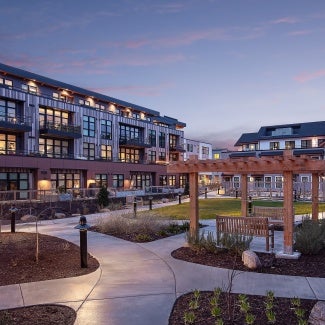
Explore the Design for Aging Review 2025 recipients, showcasing facilities that represent conscientious surroundings and advance environments for senior living.