Twenty-five Year Award 2026: Philip Merrill Environmental Center
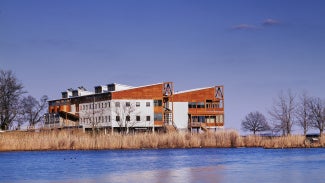
The Philip Merrill Environmental Center, designed by SmithGroup in Annapolis, Maryland, is a pioneering environmental headquarters on the Chesapeake Bay. As the world’s first LEED Platinum building, it redefined sustainable design through integrated systems, ecological restoration, and a lasting commitment to education and performance.
-
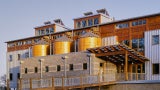
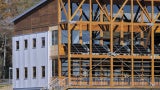
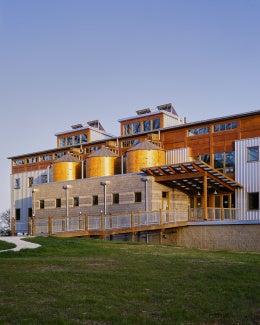 Rainwater is collected on a metal roof, routed via gutters and downspouts, through wasers to wood cistern holding tanks, which become a design feature of the north façade.
 -
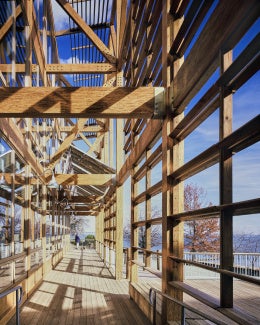 Daylighting is maximized by the narrow building depth and expansive south glazing, controlled through deep overhangs and a fixed bris-soleil.
 -
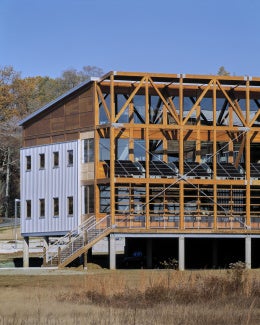 Set back 200 feet from the shore and raised on concrete piloti, the design anticipates future storm surge impacts associated with sea-level rise.
 -
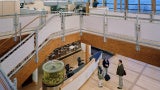
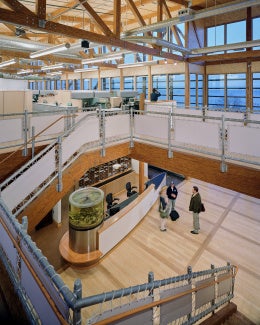 View of the lobby stairs that connect the first-floor entry and exhibit space to the second-floor staff work area.
 -
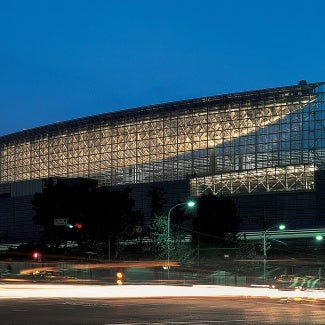
 Kawasumi-Kobayashi KenjiThe Tokyo International Forum is Japan’s leading convention and performing arts center designed for international events and cultural exchange.


Philip Merrill Environmental Center
Annapolis, Maryland | Completed 2000
The Philip Merrill Environmental Center, designed by SmithGroup, is a pioneering environmental headquarters on the Chesapeake Bay. As the first LEED Platinum building, it redefined sustainable design through integrated systems, ecological stewardship, and a lasting commitment to education and performance.
Perched along the Chesapeake Bay, the Philip Merrill Environmental Center fundamentally reshaped how architecture engages with ecology, performance, and public purpose. As the first building in the world to achieve LEED Platinum certification, it established a new paradigm for sustainable design—demonstrating, at a pivotal moment, that high-performance architecture could be both technically rigorous and deeply connected to place.
Designed as the headquarters for the Chesapeake Bay Foundation, the building operates as both workplace and living laboratory. Its narrow, elongated form is carefully oriented to harness prevailing breezes and maximize daylight, reducing reliance on mechanical systems while maintaining a high level of occupant comfort. Passive strategies—cross ventilation, solar shading, and daylighting—are integrated into the architecture itself, shaping both form and experience. As illustrated in the building section diagrams, air movement is driven through a combination of low inlet openings and higher outlet vents, enabling effective natural ventilation throughout the interior spaces.
Material and resource strategies were equally forward-thinking. The structure employs mass timber systems and structurally insulated panels, while finishes incorporate rapidly renewable and recycled materials, including bamboo flooring and reclaimed wood. Rainwater harvesting is visibly expressed through a series of exterior cisterns that collect and store water for reuse, turning infrastructure into an educational feature. Composting toilets and on-site water management reduce potable water consumption to a fraction of conventional office buildings, reinforcing the project’s holistic approach to environmental stewardship.
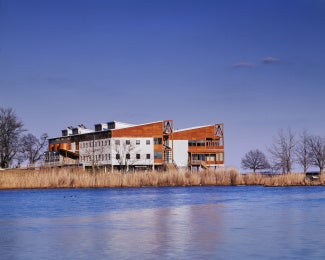
Equally significant is the project’s relationship to its site. Located on a previously developed 31-acre waterfront parcel, the building footprint occupies the least disturbed area, allowing more than 85% of the site to be restored to native ecosystems, including wetlands, meadows, and shoreline habitats. Raised on piloti and set back from the shoreline, the structure anticipates long-term climate impacts such as sea-level rise while minimizing disruption to natural systems. This integration of building and landscape transforms the site into an active educational environment, where architecture and ecology are inseparable.
Over the past twenty-five years, the Merrill Center has proven both durable and adaptable. Its open, loft-like interiors have accommodated evolving workplace needs with minimal physical alteration, while its performance systems have been continuously monitored and refined. Advances in photovoltaic technology have been incorporated over time, increasing on-site renewable energy production and extending the building’s environmental leadership. The project’s long-term operational data—shared widely with the profession—has informed subsequent generations of sustainable design, reinforcing its role as both precedent and teaching tool.
Beyond its technical achievements, the Merrill Center has had a profound cultural and educational impact. The building hosts thousands of visitors annually, including students, professionals, and community members, offering a tangible demonstration of how architecture can support environmental advocacy and stewardship. Public spaces within the building—filled with daylight and oriented toward expansive views of the bay—create an immersive experience that fosters awareness and connection to the natural world.
Today, the Philip Merrill Environmental Center stands as a touchstone for the profession. Its legacy lies not only in its early adoption of sustainable strategies but in its enduring influence—proving that architecture, when guided by ecological principles and human values, can serve as a catalyst for lasting environmental and social change.
The AIA Twenty-five Year Award is awarded to a building that has set an architectural design standard of excellence for 25–35 years.