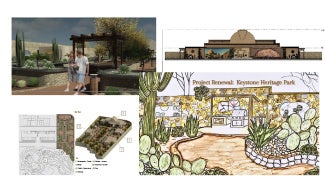
Project renewal | Keystone Heritage Park
The voting period has now closed. The winner will be announced shortly.
Design problem
The Texas Society of Architects Student Design Challenge is a statewide program that engages middle and high school students in design thinking, introducing them to architecture as a tool for problem-solving and community impact. Organized by TxA’s Education Outreach Committee, the annual competition recognizes outstanding student work across a wide range of project types—from buildings and infrastructure to speculative and non-traditional design solutions—while highlighting the next generation of designers and expanding access to the profession.
The 2025 Student Design Challenge brief, themed “Cultivate,” asks students to explore how design can foster growth—environmental, social, and cultural—through adaptive reuse, resource stewardship, and innovation. Inspired by sustainability principles and the idea that “the greenest building is one that already exists,” students are encouraged to develop creative solutions that reuse, transform, or extend existing systems while addressing real-world challenges and supporting resilient communities.
Student solution
Project renewal: Keystone Heritage Park reimagines an underfunded, deteriorating botanical garden in El Paso as a vibrant, culturally grounded, and ecologically resilient community space. The proposal preserves the site’s original identity while introducing new program elements—including an information center, café, nursery, and public amenities—to activate the park as a hub for education and gathering. Rooted in the traditions of the Tigua Tribe and regional desert architecture, the design incorporates adobe construction, local materials, and storytelling elements to reinforce cultural continuity. Sustainable strategies address existing environmental challenges through air filtration systems, water purification, and wetland restoration with native plantings. These interventions improve biodiversity, mitigate soil degradation, and enhance user experience. By adapting and revitalizing an existing site, the project embodies the 2025 “Cultivate” brief, demonstrating how design can foster environmental stewardship, cultural preservation, and community connection through thoughtful reuse and regeneration.
-
 AIA Texas Society of Architects